
NBCS 2026 Insulation & Passive Fire Protection
India has just rewritten the rulebook for how buildings are designed, insulated, and fire-protected. In April–May 2026, the Bureau of Indian Standards (BIS) replaced the National Building Code of India 2016 (NBC 2016) with the National Building Construction Standards 2026 (NBCS 2026). The change is not cosmetic. It moves India from a prescriptive regulatory regime — where the code told you exactly what to build and how — to a performance-oriented framework, where designers and specifiers must demonstrate that the finished building achieves the required fire resistance, thermal performance, and life-safety outcome by any tested route they choose.
For architects, structural and fire consultants, builders, project management consultants, and anyone specifying insulation or passive fire protection materials in India, this matters. This article walks through what has changed, what has stayed the same, and what every project team should be doing differently from now on.
Quick Summary — The Three Headline Changes
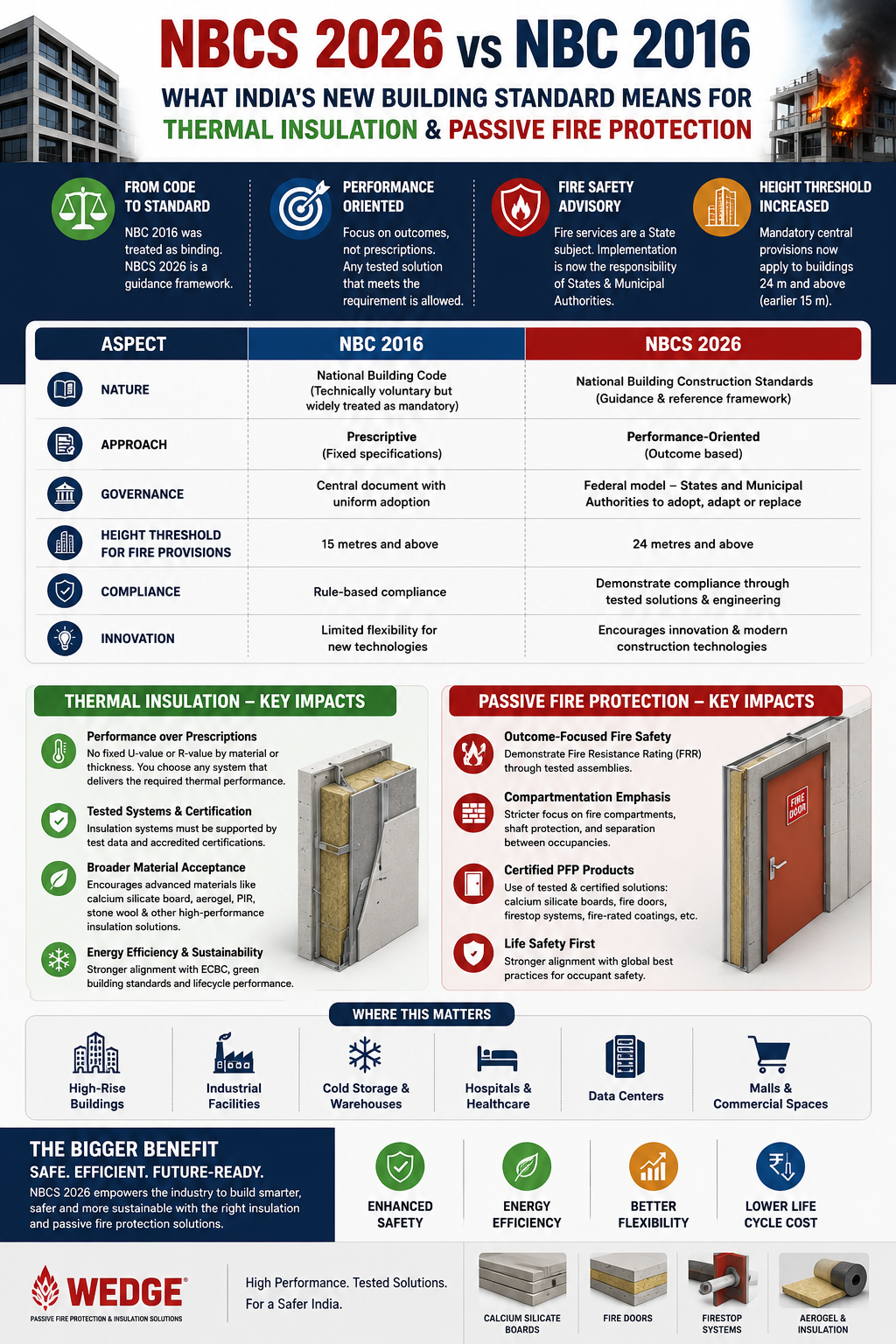
- From "Code" to "Standard." NBC 2016 was technically voluntary but widely treated as binding. NBCS 2026 is explicitly a guidance and reference framework. Implementation responsibility now sits with state governments and municipal authorities.
- From prescriptive to performance-oriented. Designers no longer follow fixed wall build-ups or fixed insulation thicknesses. They pick any tested system that delivers the required outcome — the fire resistance rating (FRR), the U-value, the acoustic rating.
- Fire and life safety is now advisory. Under the Indian Constitution, fire services are a state subject. NBCS 2026 formally recognises this. The central document is a guidance framework; states and cities adopt, adapt, or replace it.
The fire safety threshold has also shifted: mandatory central provisions now begin at 24 metres of building height, up from 15 metres under NBC 2016. A large segment of India's mid-rise stock has moved out of automatic central regulation.
1. Why the Change Was Made
Three reasons drove the shift:
Legal and regulatory clarity. Although NBC 2016 was technically voluntary, the use of the word "Code" caused widespread confusion. Courts repeatedly treated it as binding, generating disputes, project delays, and litigation. The Cabinet Secretariat's Deregulation Cell recommended replacing the code with a "Standard" framework to remove this ambiguity.
Performance-oriented innovation. The 2016 NBC's prescriptive style was out of step with modern construction technology. Slim-wall cold storage, prefabricated hospitals, aerogel-insulated retrofits, modular AI data centres, and high-strength dry-partition systems often had no clean compliance path under prescriptive rules.
Federal alignment. Fire services and building bye-laws are constitutionally state and municipal subjects. NBCS 2026 formalises a federal model — central technical guidance, state-level implementation. The BIS Fire Safety Committee chair has publicly clarified that NBCS provides "a guiding framework" and that ensuring structural and occupant safety is "the responsibility of states and municipalities."
2. NBCS 2026 vs NBC 2016 — Headline Comparison
| Aspect | NBC 2016 | NBCS 2026 |
|---|---|---|
| Title | National Building Code of India 2016 | National Building Construction Standards 2026 |
| Legal status | Termed a "Code"; widely treated as binding | Termed a "Standard"; explicitly advisory |
| Approach | Prescriptive — fixed rules | Performance-oriented — outcome-based |
| Fire & Life Safety status | Provisions referenced by state authorities as mandatory | "For guidance and referral" only — fire services explicitly recognised as a state subject |
| Height threshold for mandatory fire compliance | 15 metres | 24 metres |
| Hospital height cap | Maximum 45 m; ICUs restricted to within 30 m | No hard cap; vertical expansion permitted with enhanced fire safety provisions; ICUs preferred within 45 m |
| Material specification | Listed materials and prescribed thicknesses | Any tested system that achieves the required performance outcome |
3. What Changes for Passive Fire Protection
Under NBC 2016, a fire engineer designing a high-rise project would consult Part 4 (Fire & Life Safety) and find tabulated fire resistance ratings, prescribed compartment sizes, mandatory refuge area frequency, and specified door, wall, and floor build-ups. Compliance meant reproducing those requirements on the drawings.
Under NBCS 2026, the same engineer is given outcome targets — for example, a 2-hour FRR for a separating wall — and must demonstrate compliance through:
- BIS-listed system test reports (IS 3614, IS 12458, IS 9594)
- International equivalents (BS 476 Part 22, EN 1364, ASTM E119, UL 263)
- Engineered fire safety analysis backed by recognised software (PyroSim, FDS, Pathfinder)
- Approval by the relevant state fire authority based on the submitted documentation
Element-by-Element Changes
| Element | NBC 2016 | NBCS 2026 |
|---|---|---|
| Compartmentation | Prescribed maximum compartment sizes by occupancy class | Performance-based — sizes designed to meet fire-spread containment outcomes; flexibility for open-plan layouts |
| Fire resistance ratings (walls, beams, columns, floors) | Tabulated minimum FRR by height and occupancy | Same rating concept retained as guidance; states may vary based on local risk assessment |
| Fire doors and door assemblies | Mandatory fire-rated doors (60–120 min) at staircase enclosures, refuge areas, compartment boundaries | Specifications retained as guidance; performance demonstration via BS 476 Part 22 / IS 3614 testing becomes the compliance route |
| Intumescent fire seals & strips | Required at fire door perimeters, service penetrations, linear gaps in compartment walls | Continued recognition as a best-practice solution; designer freedom to specify equivalent tested systems |
| Structural steel fire protection | Intumescent coatings, calcium silicate board encasement, or spray-applied vermiculite mandated to achieve specified FRR | Outcome-based — any system with the required FRR via testing is acceptable |
| Mid-rise residential (15–24 m) | Subject to mandatory NBC fire safety provisions | No longer mandatorily covered at central level — falls to state rules |
| High-rise (above 24 m) | Comprehensive prescriptive package: refuge areas every 7 floors, fire lifts, sprinklers, pressurised staircases | Core requirements retained as reference; performance path now allows alternatives (e.g., natural ventilation in lieu of staircase pressurisation where externally vented) |
| Hospitals & critical-care | Strict height and compartmentation rules; ICUs limited to 30 m | Vertical expansion enabled subject to enhanced fire safety package; explicit recognition that ICUs need bespoke fire engineering |
The single biggest practical change is the 15 m to 24 m threshold shift. Under NBC 2016, any building above 15 m attracted the full residential high-rise fire safety package. Under NBCS 2026, only buildings above 24 m do automatically. Whether state rules close that gap will vary city by city.
4. What Changes for Thermal Insulation
Thermal insulation under NBC 2016 was governed primarily through Part 8 (Building Services), Part 11 (Sustainability), and cross-references to ECBC 2017 (commercial) and Eco-Niwas Samhita 2018 (residential). Material specifications sat under BIS Committee CHD 27 (Thermal Insulation).
Under NBCS 2026, this structure is preserved but its application changes:
- ECBC and Eco-Niwas Samhita continue as the primary energy efficiency instruments — they have not been replaced.
- BIS CHD 27 standards (IS 8183 mineral wool, IS 13204:2024 phenolic foam, IS 13205:2023 in-situ PUF, IS 14164 industrial application, IS 15402 ceramic fibre) remain the material specifications.
- What changes is how these are referenced — NBCS 2026 invokes them as performance benchmarks rather than fixed prescriptions.
Material-by-Material Implications
| Material / Application | What Changes Under NBCS 2026 |
|---|---|
| Aerogel insulation | Performance route allows direct specification of aerogel where thickness or weight constraints rule out conventional materials — petrochemical pipework, retrofits, slim cold-room walls, marine and offshore. Major opening for specifiers. |
| Calcium silicate boards | A single product can deliver both thermal and fire performance on industrial process plants, datacentre walls, and back-of-house separations. Performance specification rewards this dual-function capability. |
| Microporous and nano-porous insulation | Now specifiable in slim-wall and high-temperature applications where prescriptive rules previously defaulted to thicker traditional materials. |
| Vacuum insulated panels (VIP) | Recognised under the performance route for ultra-thin wall envelopes — cold-chain doors, refrigerated retail, and space-constrained refurbishments. |
| Spray foam (PUF) and PIR boards | Recognised; performance specification permits optimised spray application for industrial roofs, cold storage envelopes, and building shells. |
| High-temperature insulation (up to 1800 °C) | Same material standards apply (IS 14164, IS 15402); NBCS opens scope for industrial and process-plant insulation specifications under performance contracts. |
| Acoustic and soundproof insulation | Targets retained as guidance. Performance route allows mineral wool, glass wool, or composite assemblies to be specified by laboratory-tested STC and NRC values. |
| Cold storage thermal envelopes | Outcome-based — heat ingress (W/m²) and operating-temperature targets become primary criteria. Designers free to use PUF panels, MgO/CalSil composite walls, or hybrid systems. |
| Fire seals and passive fire protection systems | Performance-based firestopping favours systems with full BS 476 / EN 1366 reports. Tested intumescent strips, sleeves, and firestop systems become the deciding factor in tender evaluations. |
5. Why This Is an Opportunity, Not a Threat
Performance-based regulation rewards manufacturers and project teams who can produce credible test data and engineered system documentation. It disadvantages anyone selling on lowest unit price without certification.
For architects and consultants, NBCS 2026 unlocks specifications that were previously stuck in approval limbo: aerogel for slim insulation envelopes, microporous panels for back-of-furnace walls, calcium silicate boards as combined thermal-and-fire elements, MgO board partition systems with combined FRR-STC-U-value certification, and engineered firestop solutions for unusual penetrations.
For builders and developers, the relaxation of mid-rise (15–24 m) and hospital height rules creates real commercial value — but only if the enhanced fire safety provisions are properly engineered and documented.
For specifiers and PMCs, the new framework places a premium on documentation. The lowest-priced board with a 10-year-old test certificate is no longer the safe choice. The properly tested, recently certified, engineered system is.
6. Risks to Watch
Regulatory fragmentation
Twenty-eight states and eight union territories will now interpret, adapt, or selectively adopt NBCS 2026 at different speeds. A specification that satisfies one state's fire force may not satisfy another. Sales teams, consultants, and project managers should maintain a state-by-state compliance matrix.
The mid-rise (15–24 m) safety gap
Mid-rise residential and small commercial buildings now sit outside NBCS-mandatory fire provisions. Until states close this gap, builders may be tempted to value-engineer fire protection out of these projects. Insurance underwriters, project lenders, and professional liability cover will fill the gap before regulation does.
Test data validity
Performance-based regulation is only as good as the test reports that underwrite it. Any product or assembly without a current, traceable test report from an accredited laboratory risks rejection by an alert fire consultant on site.
Professional liability
Architects, structural engineers, and fire consultants now bear greater individual responsibility under the performance regime. Many are passing this risk back to material suppliers via more demanding warranty and indemnity clauses. Anyone supplying passive fire or insulation materials in 2026 should review their terms and conditions.
7. What Wedge Recommends
For project teams designing or building under NBCS 2026, we recommend three things:
- Lead specifications with test data, not material names. "2-hour FRR separating wall — calcium silicate / mineral wool / calcium silicate, tested to BS 476 Part 22, report XX-YY-ZZZZ" travels far better through a state fire authority approval than "calcium silicate board, 50 mm."
- Build a small library of fully tested system assemblies. Rather than specifying single boards, specify wall and ceiling build-ups with combined fire, acoustic, and thermal certifications. This locks out lowest-bidder substitutions.
- Engage early with state fire authorities. Karnataka, Maharashtra, Tamil Nadu, Delhi NCR, Gujarat, and Telangana are likely to publish their own implementation rules first. Submitting indicative documentation early shortens project approval cycles.
How Wedge Can Help
Wedge designs and supplies high-performance insulation and passive fire protection systems engineered for India's most demanding industrial, infrastructure, and building applications — across aerogel, microporous, calcium silicate boards, vacuum insulated panels, spray foam, high-temperature insulation up to 1800 °C, soundproof and acoustic sheets, and fire seals and passive fire protection.
Products specified under NBCS 2026 — with test data
Performance-based compliance is decided on the test report, not the material name. These are the Wedge products most often specified against NBCS 2026 outcomes. Each page carries the specification; the current test certificate is issued with the quotation.
| NBCS 2026 requirement | Specify |
|---|---|
| Fire door assemblies & door perimeter seals — performance demonstrated to IS 3614 / BS 476 Part 22 | Intumescent Door Seals · Fire Seal · Fire Barrier INT 3 mm · Fire Barrier INT 5 mm |
| Separating walls & structural steel encasement — dual thermal + fire function, tested FRR | Fireproof Calcium Silicate Boards · Calcium Silicate Board 650°C (CalSil650LD) |
| Partition systems needing combined FRR + STC + U-value certification, and moisture resistance | Wedge MgO Board 15 mm · 18 mm · 25 mm (WEMAG-S 1000) |
| Slim-envelope and retrofit insulation where thickness is the binding constraint | Vacuum Insulated Panels · Microporous Insulation |
| High-temperature process and industrial insulation paste (650–1100 °C) | W-CSP 650 · W-CSP 900 · W-CSP 1000 · W-CSP 1100 |
| Tank, vessel and pipework insulation on plant covered by the performance route | Water Tank Insulation Covers |
Browse the full insulation catalogue →
If you are specifying or sourcing under NBCS 2026 and need:
- Current test certificates for thermal and fire performance
- System-level wall, floor, or ceiling build-ups with combined FRR / STC / U-value data
- Technical support reviewing a tender, drawing, or BOQ for compliance
- Material samples, technical data sheets, or budget pricing
We can help. Wedge's technical team supports architects, fire consultants, PMCs, and project teams across India, the Gulf, the UK, Europe, Africa, the USA, and Asia.
📩 Request a Specification Review or Price Enquiry
Or contact us directly: info@wedge-india.com | +91 9717506848
www.wedgeinsulation.com/contact-us
Frequently Asked Questions
Is NBC 2016 still valid?
NBC 2016 has been superseded by NBCS 2026 at the central level. However, many state and municipal fire and building bye-laws still reference NBC 2016, and will continue to do so until state-level rules are updated. Project teams should confirm with the local authority which framework currently applies.
Does NBCS 2026 weaken fire safety?
Not in principle. The required fire resistance outcomes are similar to or stricter than NBC 2016. The change is in how compliance is demonstrated — through tested performance rather than prescribed material lists. The risk lies in inconsistent state-level enforcement and in projects that exploit the higher 24-metre threshold without commissioning equivalent state-level fire protection.
What about ECBC and Eco-Niwas Samhita?
Both remain in force. NBCS 2026 does not replace them. Energy efficiency targets — U-values, SHGC, ECBC compliance — continue to be governed by the Bureau of Energy Efficiency under those instruments.
Which states are likely to issue NBCS 2026 implementation rules first?
Based on past adoption patterns, Maharashtra, Karnataka, Tamil Nadu, Gujarat, Telangana, and the Delhi NCR municipal bodies are likely to lead. Other states will follow over the next 12–24 months.
Can my existing project under approval continue under NBC 2016?
This is determined by the relevant state and municipal authority, not by BIS. Projects already in advanced approval stages typically continue under the framework they were submitted under. Always confirm with the approving authority.
About Wedge: Wedge Insulation is part of Wedge Industries Limited, a manufacturer and supplier of high-performance insulation, refractory, and passive fire protection systems with operations across India, the UK, Europe, and global supply to over 45 countries. Learn more about Wedge.
Disclaimer: This article is provided for general information. It is not a substitute for state-specific legal or regulatory advice. Building and fire safety compliance is determined by the relevant state and municipal authority. Wedge Industries does not warrant that the information here is current for every jurisdiction in India. For project-specific advice, please contact our technical team or consult a licensed fire safety consultant.

Written by
Aishwar Bhatt
Techno-Commercial Consultant at Wedge India
Aishwar Bhatt is a Techno-Commercial Consultant at Wedge India (Wedge Industries Limited). He advises engineers, contractors and procurement teams on insulation, passive fire protection and building materials — from product selection and specifications to pricing and supply.
Connect on LinkedIn