
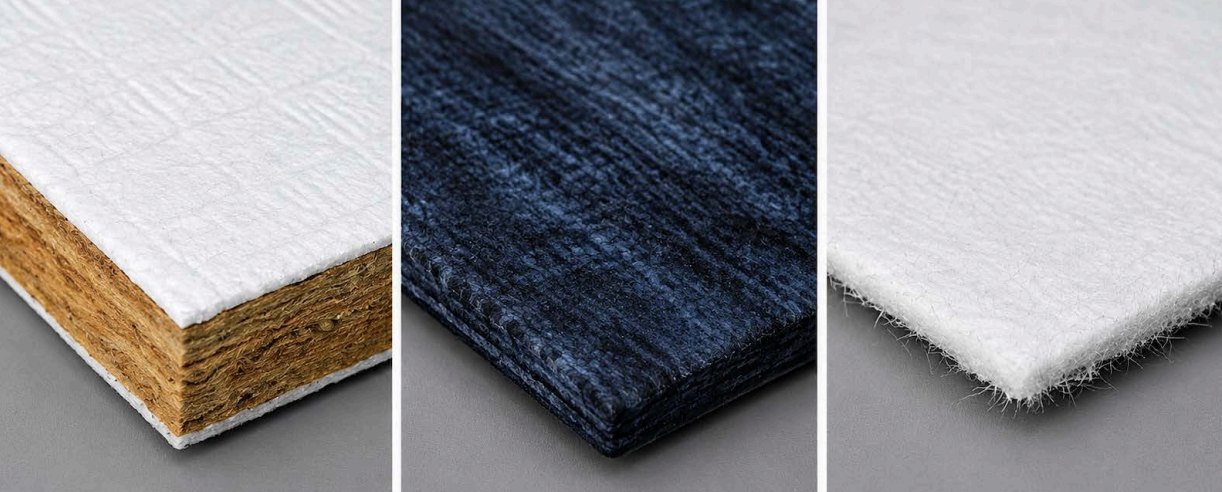
A bare 100 NB steam header running at 250 °C loses roughly 1,816 W per metre. At Indian industrial energy prices that works out to about ₹61,516 per metre per year — on a 200 m header run, more than ₹1.2 crore a year leaving the plant through the pipe wall. Fifty millimetres of mineral wool takes about ₹59,122 per metre per year of that straight back.
Most insulation specifications in India are still written from a rule of thumb or whatever thickness was used on the last job. That is how plants end up under-specified on a hot line and over-specified on a chilled one at the same time.
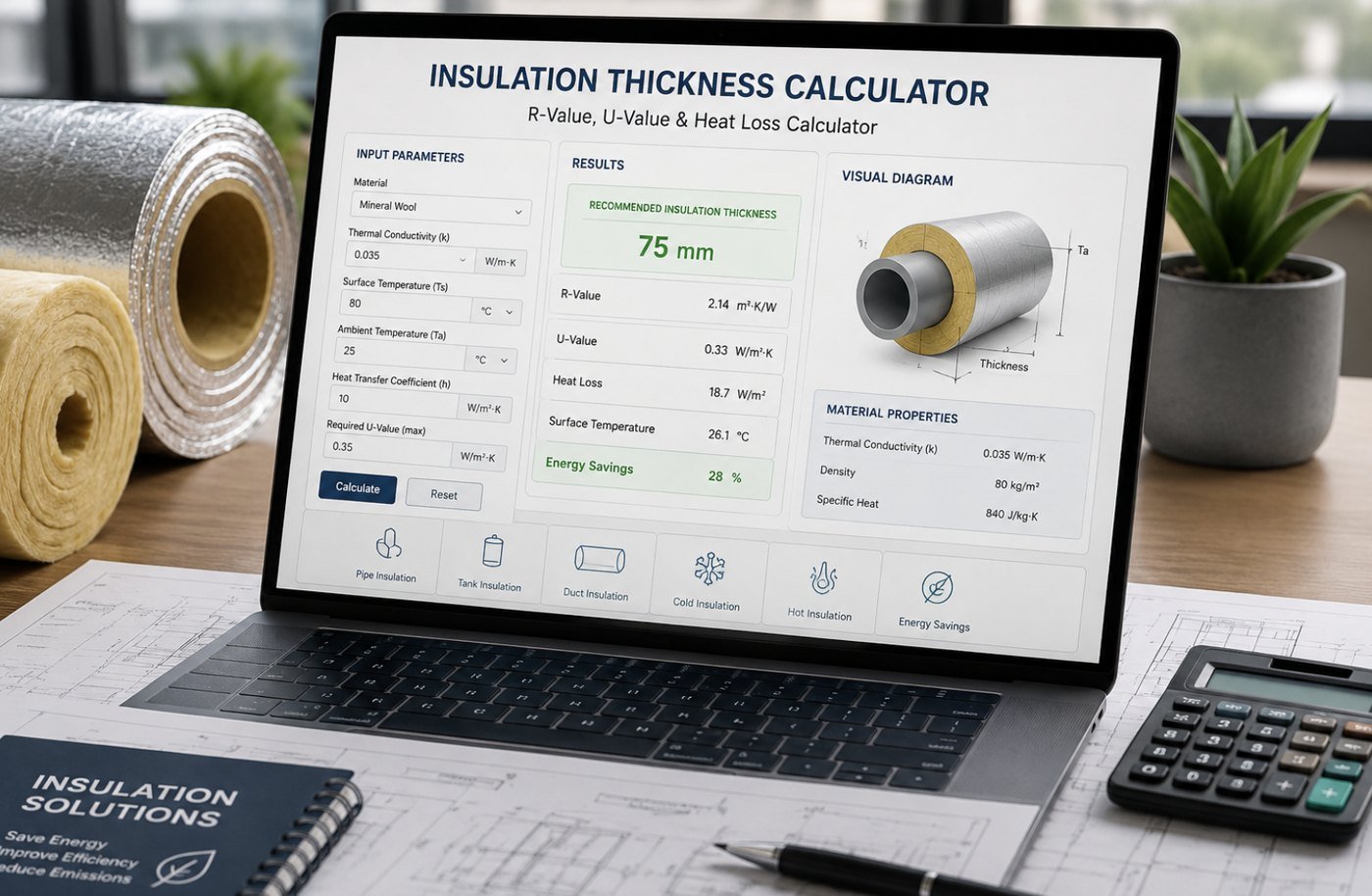
So we built the tool that does it properly. The Insulation Thickness Calculator is now live on wedgeinsulation.com — free, no sign-up, and it runs on 187 verified Wedge materials with temperature-dependent conductivity, calculated to ASTM C680, ISO 12241 and ISO 6946.
Four calculators in one tool
The tool covers the four calculations that actually appear on an insulation datasheet, and they share one material database, so the numbers stay consistent between them.
- Insulation Thickness — enter your process and ambient temperature, pipe size or flat geometry, wind speed and surface emissivity, and set a design target: a maximum surface temperature (typically 60 °C for personnel protection), a maximum heat loss, or no surface condensation. The tool returns the required thickness ranked across materials, with weight and heat loss for each.
- R-Value — build a multi-layer assembly and get the total thermal resistance, including surface films (RT) and construction-only (Rc).
- U-Value — thermal transmittance for flat walls, pipes and ducts, checked against code benchmarks.
- Heat Loss — W/m² or W/m, surface temperature, and annual running cost from your own energy tariff, system efficiency and operating hours.
All four run in the browser on a phone. Around two-thirds of the engineers who use our site are on mobile, usually standing next to the equipment they are trying to specify, so that was a hard requirement rather than a nice-to-have.
How insulation thickness is actually decided
How to Calculate Insulation Thickness? There is no single “correct” thickness for a pipe at a given temperature. Thickness falls out of whichever design constraint you are working to, and the four common ones give four different answers:
- Personnel protection — keep the outer surface below a touch-safe limit, conventionally 60 °C. This is the constraint that governs most plant piping in accessible areas.
- Process control — hold a maximum temperature drop along a line, or a maximum heat gain into a chilled system.
- Condensation control — keep the surface above the ambient dew point. On chilled water and cold-storage lines in coastal Indian humidity this usually drives thickness harder than heat loss does.
- Energy economics — the thickness where the cost of the next layer stops paying for itself. More on this below, because it is the one almost everybody gets wrong.
The calculation itself is a heat balance. Heat conducts through each layer, and leaves the outer surface by convection and radiation combined. Because thermal conductivity (λ) rises with temperature, the calculation has to iterate: guess a surface temperature, evaluate λ at each layer’s mean temperature, recompute the surface temperature, repeat until it settles. That iteration to ASTM C680 is exactly what the tool automates and what a rule of thumb skips.
R-value and U-value: the difference that matters
R-value is thermal resistance — how strongly a construction resists heat flow. It adds up across layers, and higher is better. For a single layer it is simply thickness divided by conductivity:
R = t / λ, in m²K/W, with thickness in metres.
U-value is thermal transmittance — the rate of heat flow per square metre per degree of temperature difference, and it is the reciprocal of the total R-value including inside and outside surface films. Lower is better. Building codes are written in U-values; product datasheets are written in R-values. The tool speaks both.
The practical consequence is that R-value is a property of your build-up, not of a product. Here is what 25 mm of each material family delivers, using λ at 25 °C:
| Material family | λ at 25 °C (W/mK) | R per 25 mm (m²K/W) | Max service temp |
|---|---|---|---|
| Vacuum insulated panel (VIP) | 0.0019–0.0045 | 5.6–13.2 | 100 °C |
| Aerogel blanket & panel | 0.005–0.038 | 0.66–5.0 | up to 1200 °C |
| Microporous board | 0.021–0.032 | 0.78–1.19 | up to 1260 °C |
| PIR / PUF rigid board | 0.022–0.023 | 1.09–1.14 | 120 °C |
| XPS board | 0.028 | 0.89 | 80 °C |
| Mineral wool | 0.036–0.040 | 0.63–0.69 | 650–750 °C |
| Foam glass | 0.040–0.050 | 0.50–0.63 | 480 °C |
| Calcium silicate board | from 0.040 | up to 0.63 | up to 1450 °C |
| Ceramic fibre / AES | from 0.030 | up to 0.83 | up to 1800 °C |
Two things fall out of that table. A vacuum panel does in 25 mm what mineral wool needs roughly 200 mm to do — which is why VIPs win wherever space is the binding constraint. And the high-temperature materials are not there for their λ; calcium silicate and ceramic fibre are specified because they survive 1,200 °C+, not because they insulate better than PIR.
How to Calculate Insulation Thickness? Worked example: 100 NB steam header at 250 °C
Take the header from the opening. Uninsulated, it loses about 1,816 W/m — roughly ₹61,516 per metre per year at typical Indian industrial tariffs and boiler efficiency. Add 50 mm of mineral wool and the annual saving is about ₹59,122 per metre.
Here is the part that changes how you specify. Going from 50 mm to 100 mm roughly halves the remaining loss again — but the remaining loss is already small, so the extra saving is a fraction of the first step. The first 25 mm captures about 93.8% of the total achievable saving. Everything after that is chasing the last 6%.
That single fact reframes the whole exercise. A thickness calculator gives you the minimum thickness that satisfies your design constraint. It cannot give you the economic thickness, because that depends on your tariff, your load factor, your capital cost of insulation and cladding, your installed labour rate and your payback threshold. Two plants with identical pipework and different tariffs have genuinely different correct answers.
Which material for which temperature
The tool ranks materials for you, but the shortlist is usually set by service temperature before anything else:
| Service temperature | Typical specification |
|---|---|
| −200 to 0 °C (cryogenic, cold storage) | PIR/PUF, foam glass, aerogel blanket; condensation control usually governs |
| 0 to 120 °C (HVAC, chilled water, building envelope) | PIR/PUF, XPS, mineral wool, VIP where space is tight |
| 120 to 650 °C (steam, process piping) | Mineral wool, aerogel blanket, calcium silicate |
| 650 to 1000 °C | Calcium silicate, microporous board, ceramic fibre |
| 1000 to 1800 °C (furnace, kiln, refractory backup) | Ceramic fibre / AES, microporous, high-temperature calcium silicate |
For building-envelope work the driver is code compliance rather than temperature. The U-value calculator checks your build-up against ECBC 2017 (India), UK Part L 2021, ASHRAE 90.1 and standard cold-storage practice, and tells you the PIR/PUF thickness needed to hit a target — 25 mm gets you to about 0.503 W/m²K, while 200 mm reaches 0.108 W/m²K.
How to use it: four steps
- Pick the calculator that matches your question. “How thick?” is the thickness tool. “Does this wall comply?” is the U-value tool. “What is this costing me?” is the heat loss tool.
- Enter real service conditions — process temperature, ambient, and honest wind speed. Outdoor piping at 5 m/s behaves very differently from an indoor line at still air.
- Set your design target, not a thickness. Let the tool solve for thickness.
- Compare the ranked materials on thickness, weight and heat loss together — the thinnest option is rarely the cheapest installed, and the cheapest per m² is rarely the thinnest.
Standards behind the numbers
The engine implements ASTM C680 (heat gain/loss for insulated flat, cylindrical and spherical systems), ISO 12241 (thermal insulation for building equipment and industrial installations), ISO 6946 (building components — thermal resistance and transmittance) and IS 14164 (Indian code of practice for industrial insulation, −80 to 750 °C). Material conductivities are temperature-dependent values from ASTM C177 and ASTM C335 test methods.
It is a design aid, not a substitute for a stamped design. For fired equipment, cryogenic service, hazardous area classification or anything going into a statutory submission, have the output checked by a qualified engineer.
Frequently asked questions
How do I calculate insulation thickness?
Set a design target — usually a maximum surface temperature (60 °C for personnel protection), a maximum heat loss, or no condensation — then solve the heat balance through the insulation and out from the surface by convection and radiation. Because conductivity varies with temperature the solution is iterative. The Wedge calculator runs that iteration to ASTM C680 across 187 materials and returns the required thickness for each.
What is the difference between R-value and U-value?
R-value is thermal resistance (m²K/W) and adds across layers — higher is better. U-value is thermal transmittance (W/m²K), the reciprocal of the total R-value including surface films — lower is better. Product datasheets quote R-value; building codes are written in U-values.
What insulation thickness keeps a pipe surface below 60 °C?
It depends on process temperature, pipe diameter, ambient conditions, wind speed and cladding emissivity — a 25 NB line and a 300 NB line at the same temperature need different thicknesses. Run your actual case through the thickness calculator rather than using a single figure.
Is the insulation thickness calculator free to use?
Yes. All four calculators are free, run in your browser, and need no registration. You can export the result and attach it to a quotation request.
What is economic thickness of insulation?
The thickness at which the cost of the next layer stops being repaid by the energy it saves. Because the first 25 mm captures around 93.8% of the achievable saving, economic thickness is usually close to — but not the same as — the minimum thickness the calculator returns. It depends on your tariff, load factor, installed cost and payback threshold, which is what an energy audit establishes.
Get the specification checked, or get a price
Run your case through the Insulation Thickness Calculator, then send us the result. Wedge Industries Limited manufactures across India, the UK, Spain and China and supplies to more than 45 countries, including active project supply into the UAE, Saudi Arabia, Qatar, Kuwait and Nepal.
- Request a free product quotation — attach your calculator output and we will price the material, thickness and cladding.
- Request a paid energy audit — we survey the plant, establish economic thickness against your tariff and load factor, and return a costed retrofit schedule with payback.
Related: Aerogel Portfolio Selector · Best thermal insulation for BESS · Spray foam insulation · Full product range

Written by
Aishwar Bhatt
Techno-Commercial Consultant at Wedge India
Aishwar Bhatt is a Techno-Commercial Consultant at Wedge India (Wedge Industries Limited). He advises engineers, contractors and procurement teams on insulation, passive fire protection and building materials — from product selection and specifications to pricing and supply.
Connect on LinkedIn