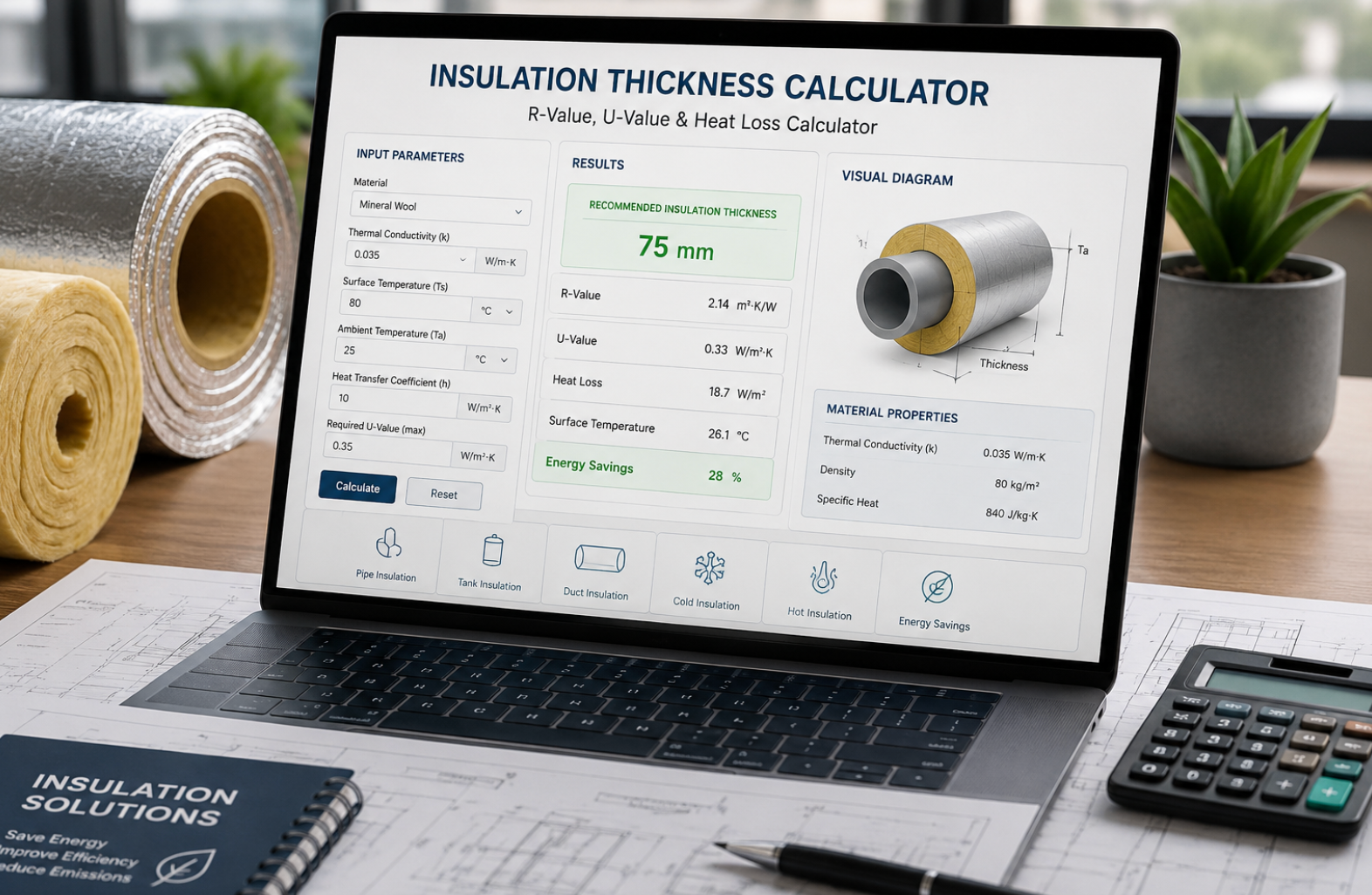
Insulation Thickness Calculator — R-Value, U-Value & Heat Loss
A free engineering-grade thermal calculator from Wedge Industries Limited. Solve for required insulation thickness, R-value, U-value, surface temperature and heat loss on pipes, ducts, vessels, walls, roofs and cold rooms — across 187 verified Wedge materials with temperature-dependent conductivity, to ASTM C680, ISO 12241 and ISO 6946.
Insulation Thickness Calculator
Find the minimum thickness that meets your design target.
Products are only offered when their service limit clears the process temperature by at least 25 °C, per Wedge selection practice.
R-Value Calculator
Thermal resistance of a multi-layer build-up, per ISO 6946.
Total R includes surface films (RT). The construction-only value (Rc, sum of layers) is reported separately — check which one your specification asks for.
U-Value Calculator
Assembly U-value with code compliance check, per ISO 6946.
Compliance figures are indicative benchmarks for guidance only — the current edition of the governing code takes precedence and thermal-bridge corrections are not included.
Heat Loss Calculator
Full ASTM C680 solution with temperature-dependent λ, surface temperature and running cost.
How to use this insulation calculator
Insulation thickness: how it is actually decided
There is no single “correct” insulation thickness. Thickness is whatever value satisfies the governing design criterion for that duty — and on most industrial jobs one of four criteria dominates.
Personnel protection
Surface temperature must be low enough that brief skin contact does not burn. Most Indian and international plant specifications set ≤ 60 °C for accessible surfaces; some tighten it to 55 °C.
Heat loss / process limit
A maximum permitted loss in W/m² (flat) or W/m (pipe), or a maximum permitted temperature drop along a line. Common on steam distribution, thermic fluid and long transfer lines.
Condensation control
On chilled water, refrigerant and cold-room surfaces, the outer face must stay above the ambient dew point. Thickness is driven by relative humidity, not by energy.
Economic thickness
The thickness where the marginal cost of the next layer equals the value of the energy it saves over the project life. This needs fuel price, hours, discount rate and installed cost — that is an energy audit, not a calculator input.
The underlying calculation
For a flat wall, the steady-state heat flux through an insulated element is:
For a pipe or cylinder, the resistance of each layer is logarithmic rather than linear, because the area grows with radius:
Two things make this harder than it looks, and both are handled by the calculator above. First, λ is not a constant — thermal conductivity rises with temperature, often by a factor of two or three between 25 °C and 800 °C, so each layer must be evaluated at its own mean temperature and re-solved iteratively. Second, hout depends on the surface temperature you are trying to find, because it combines natural or forced convection with radiation (εσ(Ts⁴ − Ta⁴)). The solution is iterative, which is exactly what ASTM C680 specifies.
Indicative insulation thickness for personnel protection
Computed with the calculator on this page: horizontal pipe, ambient 35 °C, still air, aluminium cladding (ε = 0.30), target outer surface temperature ≤ 60 °C, using WedgeMW 100 mineral wool (98 kg/m³). Values are the nearest standard manufactured thickness in millimetres.
| Process temp | 25 NB | 50 NB | 100 NB | 150 NB | 200 NB | 300 NB |
|---|---|---|---|---|---|---|
| 100 °C | 10 | 10 | 10 | 10 | 10 | 10 |
| 150 °C | 13 | 15 | 19 | 19 | 19 | 19 |
| 200 °C | 20 | 25 | 25 | 30 | 30 | 30 |
| 250 °C | 25 | 30 | 38 | 38 | 38 | 40 |
| 300 °C | 32 | 38 | 45 | 45 | 50 | 50 |
| 400 °C | 45 | 50 | 60 | 60 | 65 | 75 |
| 500 °C | 50 | 60 | 75 | 75 | 80 | 90 |
All figures in mm. Larger diameters need more thickness at the same temperature because a flat-ish large surface sheds heat more readily than a small-radius one. Change the emissivity to 0.85 (bare cement finish) and these thicknesses fall; add wind and they rise sharply. Re-run your own case in the calculator rather than reading a number off this table for a tender.
R-value: thermal resistance explained
R-value is resistance to heat flow. Higher is better. For a single homogeneous layer it is simply thickness divided by thermal conductivity:
For a real build-up you add the layers and the two surface air films, per ISO 6946:
Rsi is the internal surface resistance (0.13 m²K/W for a wall, 0.10 for a roof with heat flowing up, 0.17 for a floor with heat flowing down) and Rse is the external one (0.04 m²K/W). Specifications differ on whether they want RT (total, including films) or Rc (construction only, layers alone) — check which before you submit. The R-Value tab reports both.
Thermal conductivity and R-value by material family
λ measured at 25 °C mean temperature across the 187 products in the calculator’s database. R per 25 mm is derived directly from λ.
| Material family | λ at 25 °C (W/mK) | Density (kg/m³) | Max service temp | R per 25 mm (m²K/W) |
|---|---|---|---|---|
| Vacuum Insulated Panel (VIP) | 0.0019 – 0.0045 | 195 – 270 | 100 °C | 5.56 – 13.16 |
| Aerogel blanket & panel | 0.005 – 0.038 | 60 – 415 | up to 1200 °C | 0.66 – 5.00 |
| PIR / PUF rigid board | 0.022 – 0.023 | 42 – 50 | 120 °C | 1.09 – 1.14 |
| Microporous board | 0.021 – 0.032 | 240 – 420 | up to 1260 °C | 0.78 – 1.19 |
| XPS board | 0.028 | 30 – 48 | 80 °C | 0.89 |
| Mineral wool | 0.036 – 0.040 | 46 – 200 | 650 – 750 °C | 0.62 – 0.69 |
| Foam glass | 0.040 – 0.050 | 115 – 160 | 480 °C | 0.50 – 0.62 |
| Vermiculite | 0.048 – 0.058 | 460 – 900 | 1150 °C | 0.43 – 0.52 |
| Perlite | 0.059 – 0.062 | 220 – 350 | 650 °C | 0.40 – 0.42 |
| Ceramic fibre / AES | 0.030 – 0.69 | 65 – 1500 | up to 1800 °C | 0.04 – 0.83 |
| Calcium silicate board | 0.040 – 0.92 | 128 – 1800 | up to 1450 °C | 0.03 – 0.62 |
Ceramic fibre and calcium silicate span wide ranges because both families run from low-density insulating grades to high-density structural and back-up grades. The low-λ end of each range is the insulating grade; the high-λ end is a load-bearing board that is chosen for strength, not for R-value. λ at 25 °C is the wrong number to design a 900 °C furnace with — use the calculator, which interpolates λ at each layer’s real mean temperature.
U-value: thermal transmittance and code compliance
U-value is the reciprocal of total thermal resistance. Lower is better. It is the rate at which heat passes through one square metre of an assembly for each kelvin of temperature difference:
U-value is what building codes and cold-store specifications are written in, because it lets you compare a 200 mm PUF panel against a cavity wall with a single number. The U-Value tab also solves the inverse problem: give it a target U and it tells you the thickness of the layer you nominate.
U-value benchmarks used by the calculator
| Benchmark | Wall (W/m²K) | Roof (W/m²K) | Floor (W/m²K) |
|---|---|---|---|
| ECBC 2017 (India) — ECBC compliant | 0.40 | 0.33 | — |
| ECBC 2017 (India) — ECBC+ | 0.34 | 0.20 | — |
| ECBC 2017 (India) — SuperECBC | 0.22 | 0.15 | — |
| UK Part L 2021 — new dwelling (notional) | 0.18 | 0.11 | 0.13 |
| ASHRAE 90.1 — mass wall, hot climate (indicative) | 0.51 | 0.27 | — |
| Cold store — frozen, −18 to −25 °C (practice) | 0.16 | 0.14 | 0.20 |
| Cold store — chiller, 0 to +4 °C (practice) | 0.28 | 0.25 | 0.35 |
| Cold store — banana / potato ripening, +2 to +18 °C (practice) | 0.35 | 0.30 | 0.40 |
These are indicative benchmarks for early-stage guidance. The current edition of the governing code takes precedence, climate zone changes the required value, and none of these figures include thermal-bridge corrections (ΔU for fixings, panel joints and structural penetrations), which on a fixed panel system can add 5–15% to the as-built U-value.
PIR / PUF thickness needed to hit a target U-value
Flat wall, λ = 0.022 W/mK at 10 °C (WedgePIR 45), Rsi 0.13, Rse 0.04, insulation only — no facings or thermal bridging.
| Thickness | R of layer (m²K/W) | RT (m²K/W) | U-value (W/m²K) | Typically satisfies |
|---|---|---|---|---|
| 40 mm | 1.82 | 1.99 | 0.503 | ASHRAE 90.1 mass wall (hot) |
| 50 mm | 2.27 | 2.44 | 0.409 | Ripening chamber wall |
| 60 mm | 2.73 | 2.90 | 0.345 | ECBC compliant wall |
| 75 mm | 3.41 | 3.58 | 0.279 | ECBC+ wall · chiller wall |
| 100 mm | 4.55 | 4.72 | 0.212 | SuperECBC wall · ECBC+ roof |
| 125 mm | 5.68 | 5.85 | 0.171 | Frozen store wall (−18 to −25 °C) |
| 150 mm | 6.82 | 6.99 | 0.143 | Frozen store roof |
| 200 mm | 9.09 | 9.26 | 0.108 | UK Part L roof · blast freezer |
Heat loss: what poor insulation costs per year
Heat loss is where insulation stops being a compliance item and starts being a line on the P&L. The Heat Loss tab converts W/m² or W/m into kWh per year and then into rupees and dollars, using your own fuel price, system efficiency and operating hours.
Worked example — 100 NB steam header at 250 °C
Horizontal 114.3 mm OD pipe, ambient 35 °C, still air, 8,000 operating hours/year, boiler efficiency 85%, fuel at ₹3.60/kWh-thermal, per metre of pipe. Bare case is painted steel (ε = 0.90); insulated cases use WedgeMW 100 mineral wool under aluminium cladding (ε = 0.30).
| Insulation | Heat loss (W/m) | Surface temp | Annual energy cost | Annual saving vs bare |
|---|---|---|---|---|
| Bare pipe | 1,816 | 250 °C | ₹61,516 ($703) | — |
| 25 mm | 113 | 66 °C | ₹3,839 ($44) | ₹57,677 ($659) · 93.8% |
| 38 mm | 85 | 57 °C | ₹2,877 ($33) | ₹58,639 ($670) · 95.3% |
| 50 mm | 71 | 52 °C | ₹2,395 ($27) | ₹59,122 ($676) · 96.1% |
| 75 mm | 55 | 47 °C | ₹1,848 ($21) | ₹59,668 ($682) · 97.0% |
| 100 mm | 46 | 44 °C | ₹1,555 ($18) | ₹59,962 ($685) · 97.5% |
Indicative only, at ₹87.5 = $1. Excludes cladding, supports, labour and thermal bridging at valves, flanges and pipe shoes — uninsulated fittings routinely account for a large share of the residual loss on a real plant.
Surface temperature and condensation
On hot service, surface temperature is a safety output. On cold service — chilled water at 7 °C, refrigerant lines, cold-room walls — it is the whole design driver. If the outer face falls below the ambient dew point, water condenses on it, soaks the insulation, collapses its λ and starts corrosion under insulation (CUI). At 35 °C and 80% RH the dew point is around 31 °C, so the outer surface has to be held above that with a safety margin, typically 3 K. The Insulation Thickness tab has a dedicated no-condensation target that solves for exactly this.
Which insulation for which temperature
| Service temperature | Typical Wedge selection | Usually driven by |
|---|---|---|
| −200 to −50 °C (cryogenic, LNG) | Aerogel blanket, foam glass, VIP | Condensation, vapour barrier integrity |
| −25 to +10 °C (cold store, chilled water) | PIR/PUF panel, XPS, VIP, aerogel | U-value target, dew point |
| 10 to 80 °C (building envelope, ducting) | XPS, PIR/PUF, mineral wool, VIP | ECBC / Part L U-value compliance |
| 80 to 250 °C (hot water, LP steam) | Mineral wool, aerogel, PIR up to 120 °C | Personnel protection at 60 °C |
| 250 to 650 °C (steam headers, thermic fluid, flue ducts) | Mineral wool, aerogel blanket, calcium silicate | Heat loss and surface temperature together |
| 650 to 1100 °C (furnace linings, kilns) | Ceramic fibre / AES, microporous, calcium silicate | Hot-face limit, then shell temperature |
| 1100 to 1800 °C (high-temperature refractory) | Alumina boards, ZrO₂-bearing fibre, refractory back-up | Hot-face limit and mechanical integrity |
Browse the matching ranges: aerogel insulation, microporous / nano-porous insulation, calcium silicate boards, high-temperature insulation, vacuum insulated panels, spray foam insulation and data centre insulation. Not sure which fits? The Aerogel Portfolio Selector narrows the aerogel range by duty.
Standards and calculation method
The calculator implements a steady-state, one-dimensional heat transfer solution with temperature-dependent conductivity, iterated on both the internal temperature profile and the outer surface coefficient. The methods and data sources it follows:
| Standard | Covers |
|---|---|
| ASTM C680 | Estimating heat gain or loss and surface temperature of insulated flat, cylindrical and spherical systems by computer program — the governing method for the Thickness and Heat Loss tabs. |
| ISO 12241 | Thermal insulation for building equipment and industrial installations — calculation rules for pipes, ducts, vessels and personnel protection. |
| ISO 6946 | Building components and elements — thermal resistance and thermal transmittance calculation, including standard surface resistances. Governs the R-Value and U-Value tabs. |
| IS 14164 | Indian code of practice for industrial application and finishing of thermal insulation materials above −80 °C and up to 750 °C. |
| ASTM C177 / C335 | Guarded hot-plate and pipe-insulation test methods — the basis of the declared λ values in the material database. |
Frequently asked questions
How do I calculate the insulation thickness I need?
Fix the design criterion first, then solve for thickness. For personnel protection, set a maximum outer surface temperature (usually 60 °C) and find the thinnest standard thickness that holds the surface below it. For process duty, set a maximum permitted heat loss in W/m or W/m². For cold service, set the surface above the ambient dew point. Enter the process and ambient temperatures, wind speed and surface emissivity in the Insulation Thickness tab above and it solves all three cases against 187 materials, returning the nearest standard manufactured thickness.
What is the difference between R-value and U-value?
They are reciprocals of each other. R-value (m²K/W) measures resistance to heat flow — higher is better, and it adds up across layers. U-value (W/m²K) measures transmittance — lower is better, and it is what building codes such as ECBC 2017 and UK Part L are written in. U = 1/RT, where RT is the total resistance including the internal and external surface air films. A wall with RT = 3.58 m²K/W has a U-value of 0.279 W/m²K.
Is metric R-value the same as US R-value?
No, and mixing them is a common and expensive specification error. Metric R (RSI) is in m²K/W. US R-value is in ft²·h·°F/Btu and is 5.68 times larger for the same product — US R-13 equals RSI 2.29. Always write the unit alongside the number on drawings and datasheets.
What surface temperature is safe to touch?
Most plant specifications in India and internationally set 60 °C as the maximum for accessible insulated surfaces, with some tightening it to 55 °C in high-traffic areas. The limit depends on contact duration and surface material — a bare metal cladding at 60 °C transfers heat to skin faster than a painted mastic finish at the same temperature. Set your own limit in the calculator’s target field; it defaults to 60 °C.
Why does thermal conductivity change with temperature?
Because heat moves through a porous insulant by three mechanisms, and their balance shifts with temperature. Solid conduction through the fibre or matrix is roughly constant, gas conduction in the pores rises slowly, and radiation across the pores rises with the cube of absolute temperature. Above about 300 °C radiation dominates, which is why λ for ceramic fibre can double or triple between 25 °C and 1000 °C. A calculation that uses a single room-temperature λ will badly under-predict heat loss on hot service. The calculator interpolates λ at each layer’s own mean temperature and re-solves until the profile converges.
How much can insulation save on a steam line?
On a 100 NB header at 250 °C running 8,000 hours a year at ₹3.60/kWh, a bare pipe loses roughly 1,816 W/m — about ₹61,500 per metre per year. Applying 50 mm of mineral wool cuts that to around 71 W/m, saving approximately ₹59,100 ($676) per metre per year, with payback typically inside one heating season. Actual savings depend on your fuel price, hours, boiler efficiency and how much of the line, valve and flange area is currently uninsulated.
What thickness stops condensation on a chilled water line?
Enough to hold the outer surface above the ambient dew point plus a safety margin, usually 3 K. The dew point is set by ambient temperature and relative humidity — at 35 °C and 80% RH it is about 31 °C, so the surface must stay above roughly 34 °C. Humid coastal sites such as Mumbai, Chennai and the Gulf need noticeably more thickness than dry inland sites at the same temperature. Select the “No condensation” target in the Insulation Thickness tab and enter your site RH.
Can I use these results in a tender?
Use them for sizing, budgeting and comparison — that is what the tool is built for. Before they go into a priced tender or a contract, have the specification confirmed in writing. The calculation assumes clean, dry, uncompressed, correctly installed insulation with no thermal bridging, air gaps or moisture ingress, and materials flagged with a warning symbol have single-point or truncated λ curves that should be checked against a certified technical data sheet. Send us the calculation and our technical team will verify it and price the exact specification.
Need the economic thickness, not just the minimum?
Paid energy audit & energy-saving study
This calculator gives you the minimum thickness that meets a stated criterion. It cannot tell you the economically optimal thickness for your plant, because that depends on measured surface temperatures, real fuel cost, actual load hours, the condition of existing insulation, uninsulated valves and flanges, and your capital hurdle rate.
Wedge Industries Limited carries out chargeable thermal energy audits and energy-saving studies: thermographic survey of the line or envelope, measured baseline heat loss, economic-thickness optimisation, a prioritised scope of work with quantities, and a payback model in ₹ and $. The output is a document you can take to your board or to a tender.
- Thermographic and contact-temperature survey of hot and cold surfaces
- Measured baseline heat loss and annual energy cost, per line and in total
- Economic thickness optimisation against your fuel price and hours
- Prioritised remediation scope with quantities, budget and payback
- Cold-store and building envelope U-value compliance assessment
Scope and fees are quoted per site after a short scoping call. Free product quotations remain free — the charge applies only to audit and energy-study work.
Delhi · Mumbai · Gurgaon · Lucknow · London · China
Exported to 45+ countries
Related tools and resources
Accuracy and limitations
Calculations follow ASTM C680 (steady-state one-dimensional heat transfer with the ASTM C680 outer surface coefficient), ISO 12241 (pipe and equipment insulation), ISO 6946 (building components) and IS 14164 where applicable. Results are engineering estimates for preliminary selection and budgeting: they assume clean, dry, correctly installed insulation with no thermal bridging, air gaps, mechanical compression or moisture ingress. Conductivity data is Wedge Industries Limited catalogue data at the stated mean temperatures; products flagged with a warning symbol have single-point or truncated λ curves and must be confirmed against a certified technical data sheet before being used in a tender or contract. Prices and energy costs shown are indicative and change with market conditions. Wedge Industries Limited accepts no liability for design decisions taken on the basis of this tool — have any critical design verified in writing by our technical team.