
Aerogel Cost in India (2027): Per m², Per kg, Per Pipe Metre and Installed
Aerogel blanket costs ₹1,350–₹4,500 per m² ($14–$47) at project quantity, about ₹125–₹420 per sq ft, ₹1,400–₹2,200 per kg, or ₹620–₹2,900 per metre of insulated pipe. This page shows what drives that cost, how the installed cost compares with mineral wool and calcium silicate, and when the higher material price pays back.
How much does aerogel cost?
In India, industrial aerogel blanket costs ₹1,350–₹4,500 per m² ($14–$47) ex-works Faridabad for orders of 100 m² and above, excluding 18% GST. A 5 mm blanket for surfaces up to 400 °C starts at about ₹1,350/m²; 10 mm costs ₹2,450–₹3,850/m² depending on temperature grade; 15–20 mm and speciality grades reach ₹4,500/m². Sample quantities under 20 m² cost 20–30% more. Prices updated 01-10-2026 at ₹96 per US$.
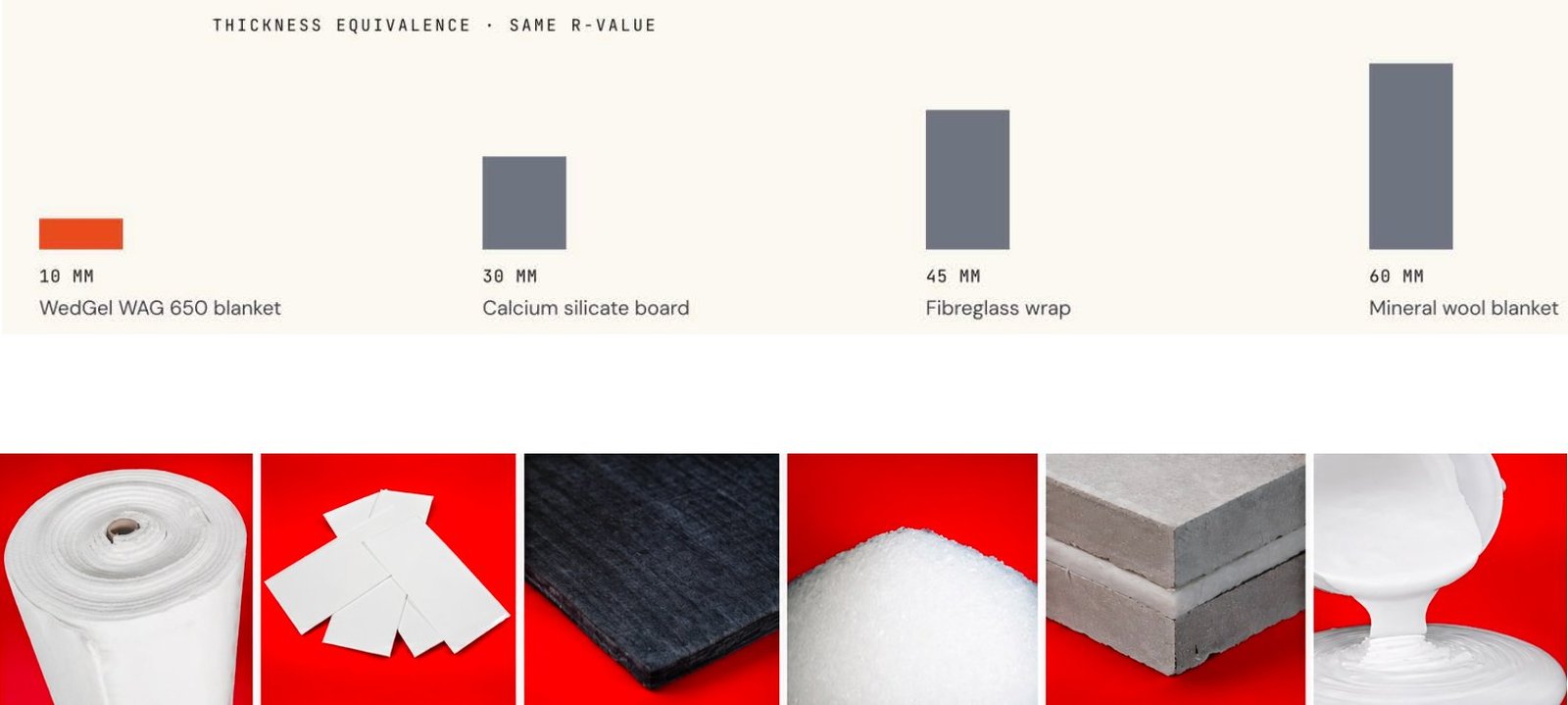
Those are material prices. The cost that matters on a project is the installed system cost per metre of pipe or per m² of wall, including cladding, supports, labour and the fuel the insulation saves over its life. Aerogel is 3–5 times dearer than mineral wool per m² of the same thickness, but because 10 mm of aerogel does the work of 30 mm of calcium silicate or 60 mm of mineral wool blanket, the comparison per m² is the wrong one. The sections below give the cost per m², per kg, per pipe metre and per installed system so you can compare like with like.
Aerogel cost per m² by thickness and grade
| Blanket thickness | Ambient grade (up to 400 °C) | 650 °C grade | Per sq ft (ambient grade) |
|---|---|---|---|
| 5 mm | ₹1,350–1,750 ($14–18) | ₹1,650–2,150 ($17–22) | ₹125–163 |
| 6 mm | ₹1,550–2,000 ($16–21) | ₹1,900–2,450 ($20–26) | ₹144–186 |
| 10 mm | ₹2,450–3,150 ($26–33) | ₹2,950–3,850 ($31–40) | ₹228–293 |
| 15–20 mm and speciality grades | up to ₹4,500 ($47): silica-cloth 650HP, marine 125A-M, foil-laminated 150AL, carbon composite CAC350 | up to ₹418 | |
Indicative cost per m² for project quantities (100 m² and above), ex-works Faridabad, excluding GST and freight, at ₹96 per US$. Square-foot figures divide by 10.764. The full tier structure (sample, trade, project, 1,000 m²+) and roll prices are on the aerogel price in India page.
Aerogel cost per kg and per gram
Aerogel blanket is sold by area, not weight, but buyers often ask for a per-kg figure. WedGel blankets weigh 180–200 kg/m³, so a 10 mm blanket is about 1.8–2.0 kg per m². Dividing the per-m² price by that weight gives roughly ₹1,400–₹2,200 per kg ($15–$23), or ₹1.40–₹2.20 per gram.
Per-gram prices seen on marketplaces (a few hundred to a few thousand rupees for a small block) are for laboratory monoliths, hand-made by supercritical drying and sold as curiosities. They say nothing about the cost of insulating a plant. Aerogel powder and granules, which are sold by the kilogram, are quoted per enquiry because the grade, particle size and quantity change the price. Background on the material itself: what aerogel is and how it is made.
Aerogel cost per metre of pipe
For pipe insulation the useful figure is the material cost per running metre. It depends on the pipe diameter and the blanket thickness, because the blanket wraps the outside of the pipe: area per metre = π × (pipe OD + 2 × thickness). The table uses 10 mm of blanket, one layer, and the per-m² bands above.
| Pipe size (OD) | Blanket area per metre, 10 mm | Ambient grade, ₹ per metre | 650 °C grade, ₹ per metre |
|---|---|---|---|
| DN50 (60.3 mm) | 0.25 m² | ₹620–795 ($6–8) | ₹745–970 ($8–10) |
| DN100 (114.3 mm) | 0.42 m² | ₹1,035–1,330 ($11–14) | ₹1,245–1,625 ($13–17) |
| DN150 (168.3 mm) | 0.59 m² | ₹1,450–1,865 ($15–19) | ₹1,745–2,280 ($18–24) |
| DN200 (219.1 mm) | 0.75 m² | ₹1,840–2,365 ($19–25) | ₹2,215–2,890 ($23–30) |
| DN300 (323.9 mm) | 1.08 m² | ₹2,645–3,400 ($28–35) | ₹3,185–4,160 ($33–43) |
Material only, one 10 mm layer, no overlap allowance (add 5–10% for overlaps, flanges and valves). Two layers of 10 mm, or a 15–20 mm blanket, are typical above 400 °C. For a sized estimate send your line list; for a quick check use the insulation thickness calculator.
What drives the cost of aerogel
Installed cost: aerogel vs mineral wool vs calcium silicate
Material is only part of the system cost. A thinner insulation layer means a smaller outer diameter, so less cladding sheet, lighter support rings, fewer layers to fit and faster work on flanges and valves. Aerogel blanket is cut with a knife and wrapped by hand; calcium silicate is cut as rigid half-sections and needs more joints to seal.
| Cost element | Aerogel blanket (10 mm) | Mineral wool (60 mm equivalent) | Calcium silicate (30 mm equivalent) |
|---|---|---|---|
| Material cost per m² of the same thickness | Highest (3–5× mineral wool) | Lowest | Medium |
| Thickness for the same heat loss | 10 mm (reference) | about 60 mm | about 30 mm |
| Cladding area, DN100 pipe | 0.42 m²/m | 0.74 m²/m (+75%) | 0.55 m²/m (+30%) |
| Weight on supports, DN100 pipe | about 0.8 kg/m | about 3–5 kg/m | about 3–5 kg/m |
| Installation | Knife-cut, wrapped, taped or banded; no special tools | Wired or banded, needs care at joints and to stay dry | Rigid sections, more joints, mastic at seams |
| Water behaviour | Hydrophobic (99%), vapour-permeable; stays dry | Absorbs water unless treated; wet wool loses most of its R-value | Absorbs water |
| Corrosion under insulation (CUI) | Low risk, ASTM C795 / C1617 compliant | Known CUI driver when wet | Moderate |
| Service life | Life of plant, no settling | Often replaced after water ingress | Long if kept dry |
| Where it costs less overall | Space-limited lines, CUI-prone plants, high-value heat, retrofits, offshore, cryogenic | Dry, open areas with no space or weight limit | Furnace backing, fire walls, high-load surfaces |
Weights and competing-material thicknesses are typical published values for comparison; cladding areas are calculated for a DN100 pipe (OD 114.3 mm). Mineral wool and calcium silicate prices vary by supplier and are not quoted here. Wedge Industries Limited also supplies calcium silicate boards and microporous insulation where they are the better-value choice.
When aerogel’s cost pays back
Hot process lines and steam
On 200–650 °C lines the energy saved per metre is large, and aerogel’s thin, dry layer holds its R-value for the life of the plant. The extra material cost is typically recovered from fuel savings in one to three years, faster where wool would otherwise be replaced after getting wet.
Space-limited and retrofit work
Where a 60 mm wool layer will not fit between pipes, under a deck or inside a cabinet, aerogel is often the only option, and avoids re-routing or structural changes that cost far more than the blanket.
Corrosion-prone plants
Refineries, coastal and offshore sites spend heavily on CUI inspection and pipe replacement. Hydrophobic aerogel removes the wet-insulation cause, so the cost case is about avoided maintenance rather than fuel.
Cryogenic and LNG
Cold lines reward low conductivity twice: less boil-off and less ice. Aerogel’s thin layer also cuts the cladding and support cost of cryogenic systems.
EV, BESS and electronics
A 1–2 mm aerogel pad between cells costs a fraction of the battery it protects. Here the cost is judged against the thermal-runaway risk, not against other insulation.
Where it does not pay
Dry, open-air, low-temperature duty with unlimited space, such as a warehouse roof or an ambient chilled-water header with room for 50 mm of foam. Use mineral wool, PUF or XPS there and keep aerogel for the lines that justify it.
Worked example: 100 m of DN100 steam line at 300 °C
A plant wants to insulate 100 m of DN100 saturated-steam line running at about 300 °C surface temperature. The heat-loss calculation calls for 10 mm of aerogel or 60 mm of mineral wool for the same surface temperature and loss.
| Item | 10 mm WedGel WAG400 aerogel | 60 mm mineral wool |
|---|---|---|
| Insulation area | 42 m² (0.42 m²/m) | about 74 m² (0.74 m²/m) |
| Aerogel material cost | ₹1.03–1.32 lakh ($1,070–1,380) at ₹2,450–3,150/m² | Mineral wool: quoted by your wool supplier |
| Cladding (aluminium or GI sheet) | 42 m² plus overlaps | 74 m² plus overlaps (+75%) |
| Weight added to supports | about 80 kg | about 300–500 kg |
| Labour | One wrap, knife-cut, banded | Thicker layer, more wiring, more cladding to fit |
| Risk of rework | Stays dry; no CUI programme needed for wet insulation | Replacement likely if the cladding leaks |
The aerogel material line is higher. Against it stand 32 m² less cladding, roughly 300–400 kg less load on supports, a faster install and no wet-insulation replacement. On a steam line at this temperature the fuel saved by keeping the insulation dry over ten years is many times the material difference, which is why most refineries and power plants now specify aerogel on their hot, space-tight and CUI-prone lines. Send your line list and we will return the same table with your quantities and a firm price.
How to reduce the cost of aerogel on your project
- Size the thickness properly. Most lines under 400 °C need 5–10 mm, not 20 mm. Use the thickness calculator or ask for a free heat-loss sizing.
- Choose the right grade. WAG400 for process lines up to 400 °C, ECO for budget-led 650 °C duty, WAG650 only where its 650 °C rating and lower hot-face conductivity are needed.
- Buy plain blanket where you can. Facings add cost; use foil or cloth only where the spec or the environment demands it.
- Order at project quantity. 100 m² and above gets the project tier; pool small lines into one order rather than buying samples twice.
- Use standard roll widths. Custom slit widths and die-cut shapes are priced per piece; standard rolls cut on site are cheapest.
- Buy from the manufacturer. WedGel is made in India by Wedge Industries Limited, with ready stock, so you pay no import or distributor margin and no factory lead time.
Cost of other aerogel forms
| Form | How it is costed | Cost note |
|---|---|---|
| Blanket | per m², by thickness and grade | ₹1,350–4,500/m² at project tier (this page) |
| Felt / sheet | per m² or per sheet | Similar to blanket of the same thickness; quoted per enquiry |
| EV and BESS pads | per piece, by size and thickness | Die-cut and encapsulated; quoted on drawing and quantity |
| Rigid board / panel | per m² or per panel | Quoted per enquiry |
| Granules and powder | per kg | Quoted by grade, particle size and quantity |
| Paint and coating | per litre or per kg, by coverage | Quoted per enquiry with coverage per m² at the specified thickness |
| Vacuum insulation panel | per panel or per m² | Quoted per enquiry; see VIP page |
Shop aerogel by grade
-
Aerogel Insulation
WedGel WAG400 Low Cost Aerogel Blanket for Process Pipes (up to 400°C)
Contact for Price 📩 Contact for Price -
Aerogel Insulation
WedGel ECO Cost Optimised Aerogel Blanket up to 650°C
Contact for Price 📩 Contact for Price -
Aerogel Insulation
WedGel WAG650 Commercial Grade Aerogel Blanket up to 650°C
Contact for Price 📩 Contact for Price -
Aerogel Insulation
WedGel 200 Standard Cryogenic Aerogel Blanket — -200 to +200 °C Service
Contact for Price 📩 Contact for Price -
Aerogel Insulation
WedGel 650HP Silica Cloth Premium Aerogel Blanket for HP Steam & Turbines
Contact for Price 📩 Contact for Price -
Aerogel Insulation
WedGel CAC350 Carbon Aerogel Composite — Premium EV Thermal Runaway Barrier
Contact for Price 📩 Contact for Price




View all 53 aerogel products →
Related guides
- Aerogel price in India (2027): the full price list by grade, tier and roll.
- Aerogel: what it is, what it is made of and what it is used for.
- Silica aerogel: properties, structure and types.
- Aerogel insulation: the 25-grade WedGel selector and specifications.
- How to calculate insulation thickness and the calculator.
- What is aerogel insulation? and aerogel for BESS.
Aerogel cost FAQs
How much does aerogel cost in India?
Aerogel blanket costs ₹1,350–₹4,500 per m² ($14–$47) for project orders of 100 m² and above, ex-works Faridabad, excluding 18% GST. A 5 mm ambient-grade blanket starts at about ₹1,350/m²; 10 mm costs ₹2,450–₹3,850/m² depending on the temperature grade. Samples under 20 m² cost 20–30% more.
What is the cost of aerogel per kg?
About ₹1,400–₹2,200 per kg ($15–$23) for blanket, derived from the per-m² price and a density of 180–200 kg/m³. Aerogel is sold by area, so ask for a per-m² price. Powder and granules, which are sold per kg, are quoted per enquiry.
What is the cost of aerogel per square foot?
₹125–₹420 per sq ft, which is the ₹1,350–₹4,500 per m² range divided by 10.764. A 10 mm blanket for surfaces up to 400 °C is about ₹228–₹293 per sq ft.
How much does it cost to insulate a pipe with aerogel?
With one 10 mm layer, material costs about ₹620–₹970 per metre on a DN50 pipe, ₹1,035–₹1,625 per metre on DN100 and ₹1,840–₹2,890 per metre on DN200, depending on the grade. Add 5–10% for overlaps and fittings, plus cladding and labour.
Why is aerogel so expensive?
The drying step. Aerogel is made by forming a silica gel and removing the liquid without collapsing its nanometre pores, by supercritical CO₂ or carefully controlled ambient-pressure drying. That step, plus the silica precursors and the fibre carrier, makes a blanket cost more per m² than wool or foam. Continuous blanket lines have brought the cost down to ₹1,350–₹4,500/m², which is why aerogel is now a routine industrial product rather than a laboratory material.
Is aerogel cheaper than mineral wool overall?
Per m² of the same thickness, no: aerogel costs 3–5 times more. Per installed system, often yes, because 10 mm of aerogel replaces about 60 mm of mineral wool blanket, which cuts cladding area by up to 75% on small pipes, removes most of the weight on supports, and avoids replacing wool that has got wet. On hot lines the fuel saved usually recovers the difference within one to three years.
Does the price include GST, freight and installation?
No. Prices are ex-works Faridabad and exclude 18% GST, freight and installation. Freight is small because aerogel is light. Installation can be quoted separately through our insulation contractor service in Delhi NCR, Mumbai, Pune, Ahmedabad, Bangalore, Chennai, Kolkata and other cities.
How can I reduce the cost of aerogel on my project?
Size the thickness with a heat-loss calculation rather than a round number, pick the lowest grade that meets the temperature (WAG400 for up to 400 °C, ECO for budget-led 650 °C duty), buy plain blanket in standard roll widths, order at project quantity (100 m² and above), and buy directly from the manufacturer.
What does aerogel paint or powder cost?
Aerogel paint and coatings are priced per litre or per kg with a stated coverage per m² at the specified thickness; powder and granules are priced per kg by grade and particle size. Both are quoted per enquiry because quantity and specification move the price. Send the surface area or quantity and we will reply within one working day.
Will aerogel cost change in 2027?
The bands on this page were updated 01-10-2026 and apply to 2027 project enquiries. Raw-material and currency movements can shift them, so quotations are valid for a stated period. For a firm 2027 price, send your quantities and grades and we will confirm in INR or USD.
Get a firm aerogel cost for your project
Send your line list or area in m², the operating temperature and the grade if known. Our engineers will size the thickness, work out the quantity and send a price in INR or USD within 24 hours.
Last updated 02-10-2026 by the Wedge Industries Limited technical team. Prices are indicative and confirmed by written quotation.