
By the Wedge Industries Limited technical team · Updated 19-09-2026 · Data from the WedGel catalogue 2026 (ASTM C1728)
Aerogel insulation is a silica gel that has been dried so that air replaces the liquid, leaving a solid that is more than 90% air trapped in nanometre-sized pores. Those pores stop heat moving through the material, which gives aerogel a thermal conductivity of about 0.018 W/m·K at 25 °C, two to four times lower than mineral wool or fibreglass. It is supplied as flexible blankets, rigid boards, paint and powder, and works from −200 °C to 1,200 °C.
This guide explains how aerogel works, the forms it comes in, where each industry uses it, the full WedGel range with technical data, and the myths worth clearing up before you specify it.
Talk to an insulation engineer. Send your application, operating temperature and area on WhatsApp for the right WedGel grade and thickness, with the TDS attached.
What is aerogel insulation and how does it work?
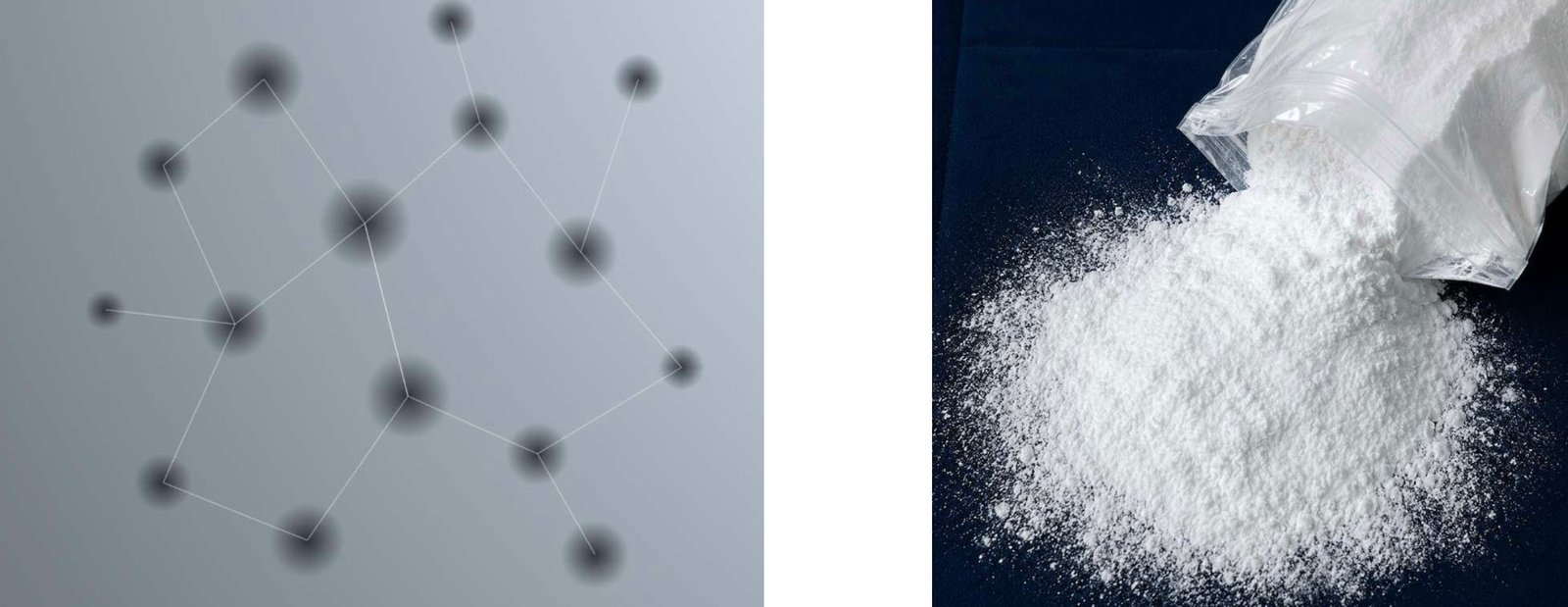
Aerogel is made by forming a silica gel and then removing the liquid without letting the pore structure collapse, either by supercritical drying or by a surface-treated ambient-pressure process. What remains is a network of silica strands with pores 20 to 50 nm wide and a porosity of 90 to 98%.
Heat crosses an insulation material in three ways. In aerogel, all three are blocked at once:
- Convection stops because air molecules cannot move freely in pores smaller than their mean free path (about 70 nm).
- Solid conduction is tiny because the silica skeleton is only a few percent of the volume and the path through it is long and tortuous.
- Radiation is scattered by the fine structure, and carbon or opacifier additives cut it further in high-temperature grades.
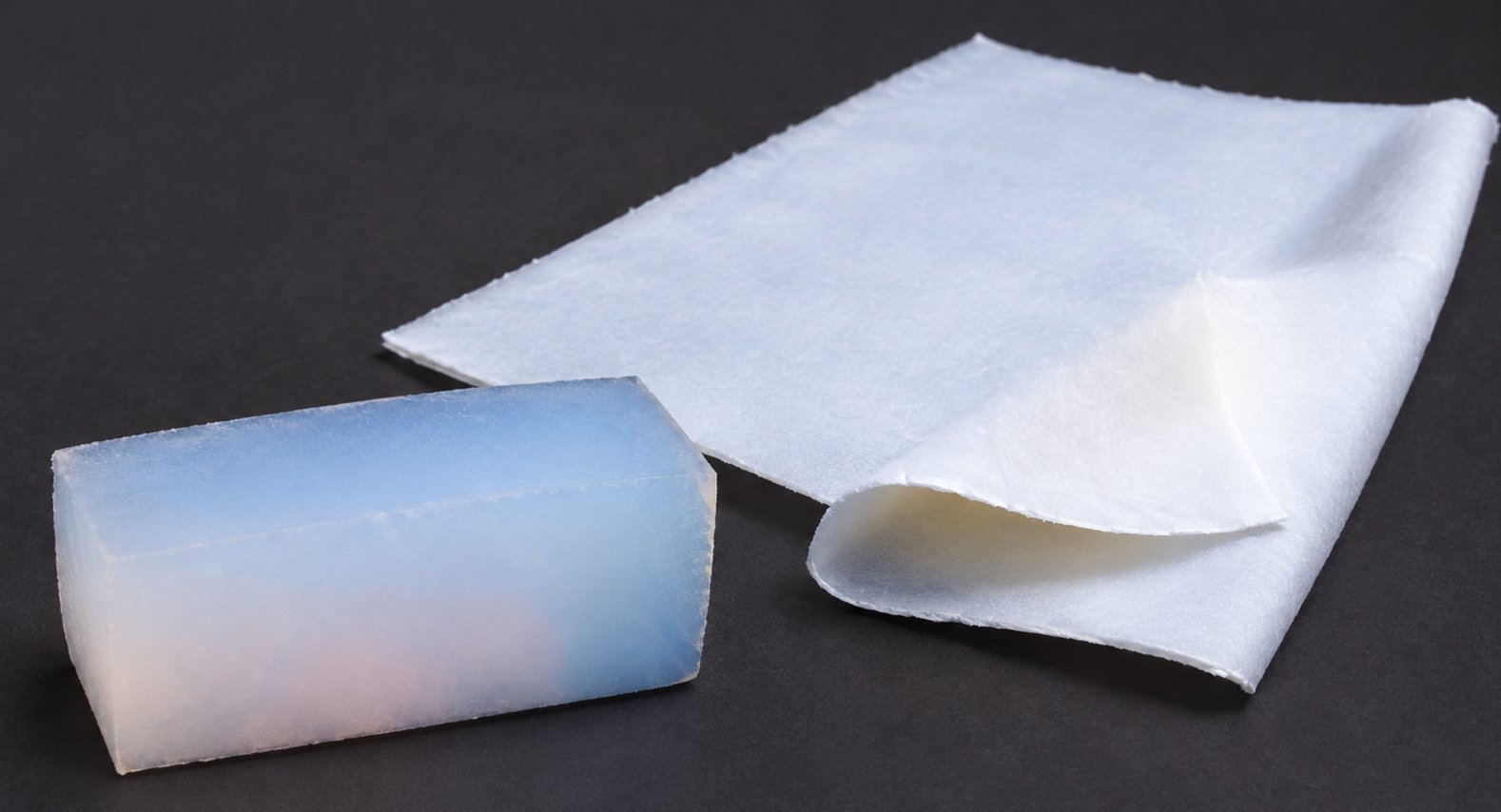
Pure aerogel monoliths are brittle, so industrial aerogel is grown inside a fibre mat, giving a flexible blanket that can be wrapped, cut with a knife and banded like mineral wool. The material was first made in 1931 and became widely known through NASA, which used it to capture comet dust and insulate Mars rovers. Today it is a standard industrial insulation covered by ASTM C1728.
Aerogel vs fibreglass vs rockwool vs calcium silicate
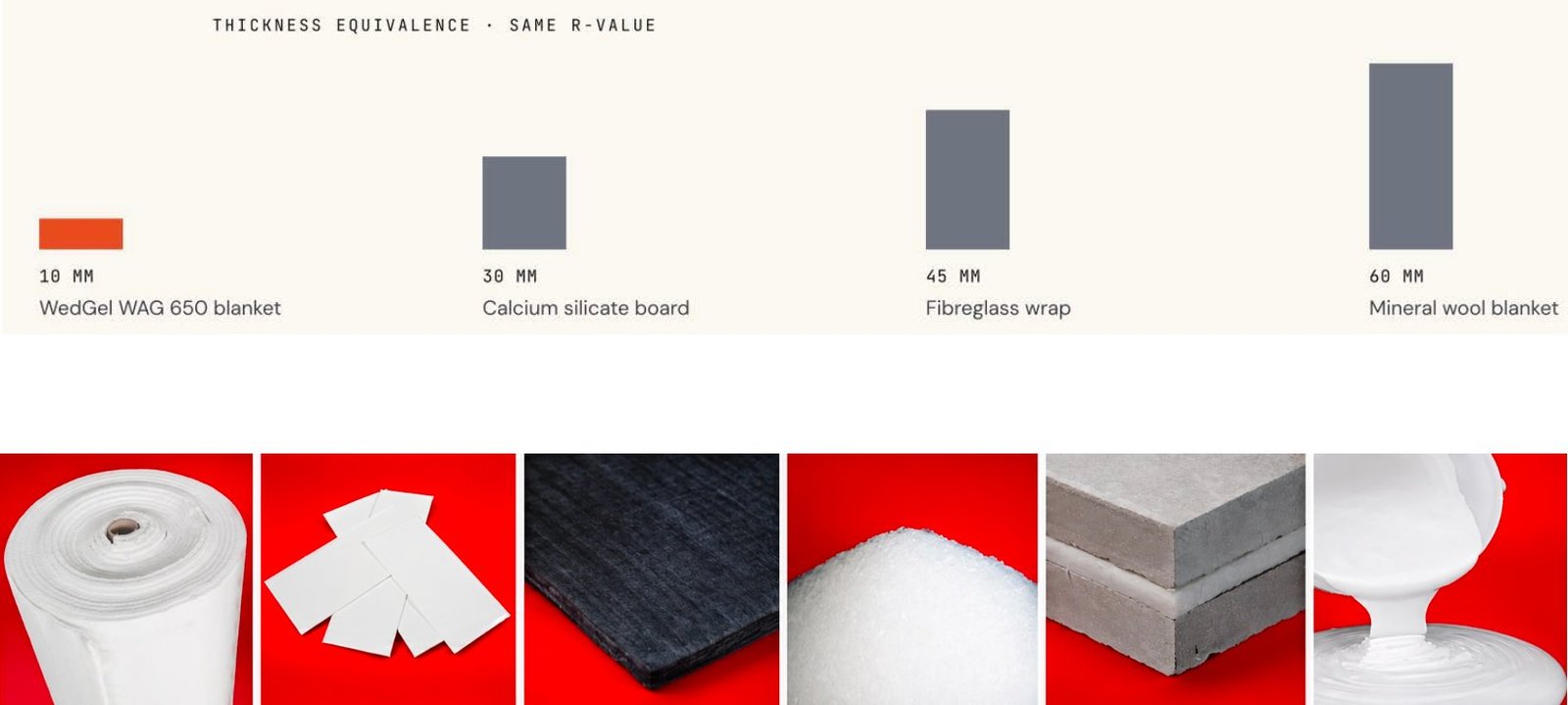
The practical difference is thickness. For the same heat loss, 10 mm of WedGel WAG650 aerogel blanket does the work of about 30 mm of calcium silicate board, 45 mm of fibreglass wrap or 60 mm of mineral wool blanket. On a congested pipe rack, inside an equipment guard or on a façade where every millimetre of wall depth is floor area, that is the whole argument.
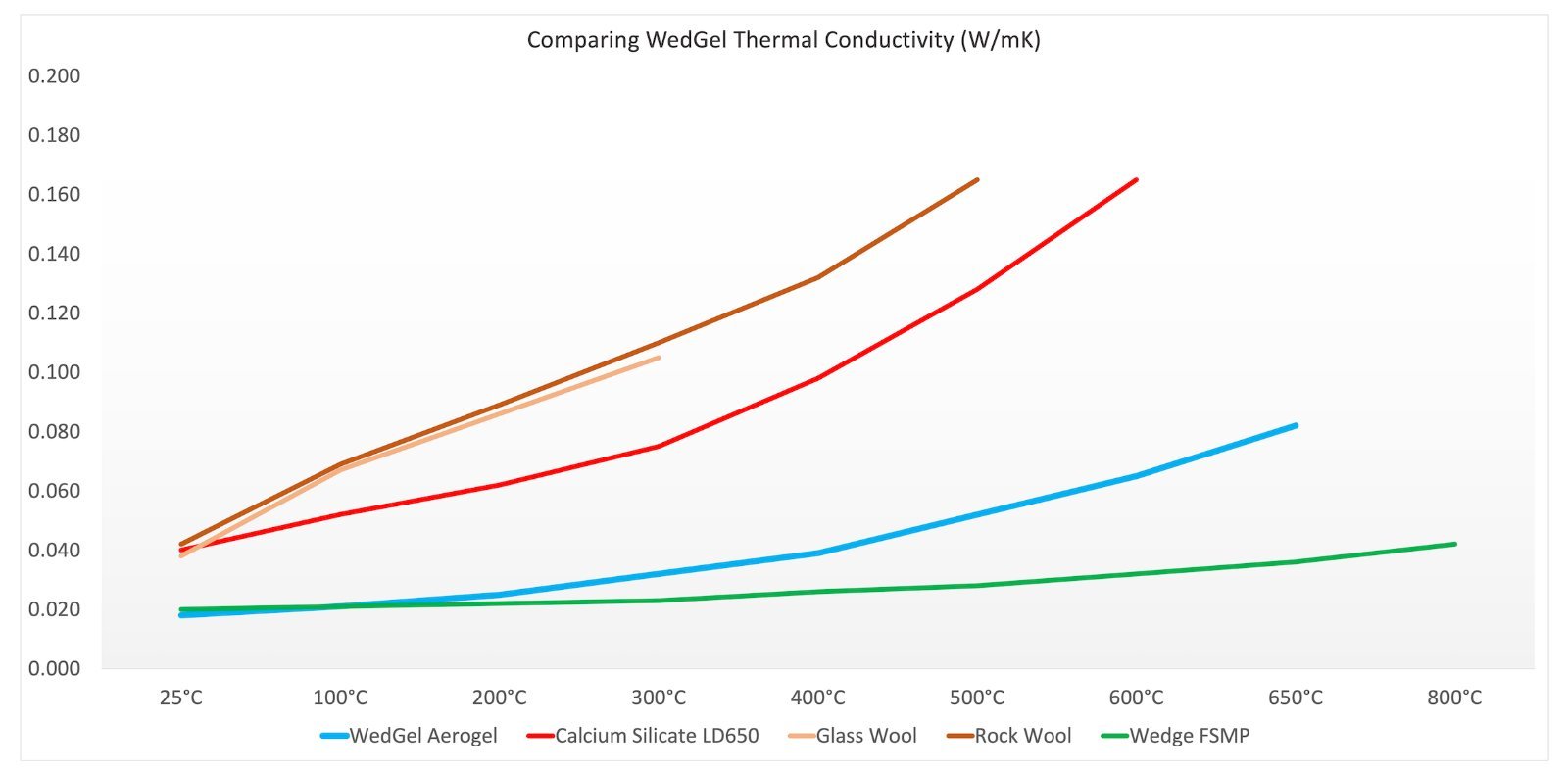
The gap widens as temperature rises. Mineral wool and glass wool pass 0.10 W/m·K by 300 °C; WedGel aerogel is still below 0.04 W/m·K at 400 °C and reaches 0.068 W/m·K only at 600 °C. Wedge FSMP microporous panels go further still for furnace and kiln backing above 650 °C.
| Property | WedGel aerogel blanket | Mineral / rock wool | Fibreglass | Calcium silicate |
|---|---|---|---|---|
| λ at 25 °C, W/m·K | 0.018 | 0.040 | 0.038 | 0.040 |
| λ at 300 °C, W/m·K | 0.035 | 0.105 | 0.105 | 0.075 |
| Thickness for same R-value | 10 mm | 60 mm | 45 mm | 30 mm |
| Max service temperature | 650 °C (1,200 °C BL50) | 650–750 °C | 350 °C | 1,000 °C |
| Water behaviour | Hydrophobic, 99% | Absorbs unless treated | Absorbs | Absorbs |
| Form | Flexible blanket | Blanket / slab | Wrap / batt | Rigid board |
| Fire class | A1 / A | A1 | A1 | A1 |
| Price per m² | Highest | Low | Lowest | Medium |
Where space, weight and moisture are not constraints, wool and calcium silicate remain cheaper installed. Our aerogel price guide for 2027 gives ₹ and $ per m² by thickness, and the insulation thickness calculator lets you compare options for your own line.
The forms aerogel comes in
Aerogel is one material sold in five forms. Choose by the shape of the surface and the way the job will be installed.
Aerogel blanket and roll: the lead product
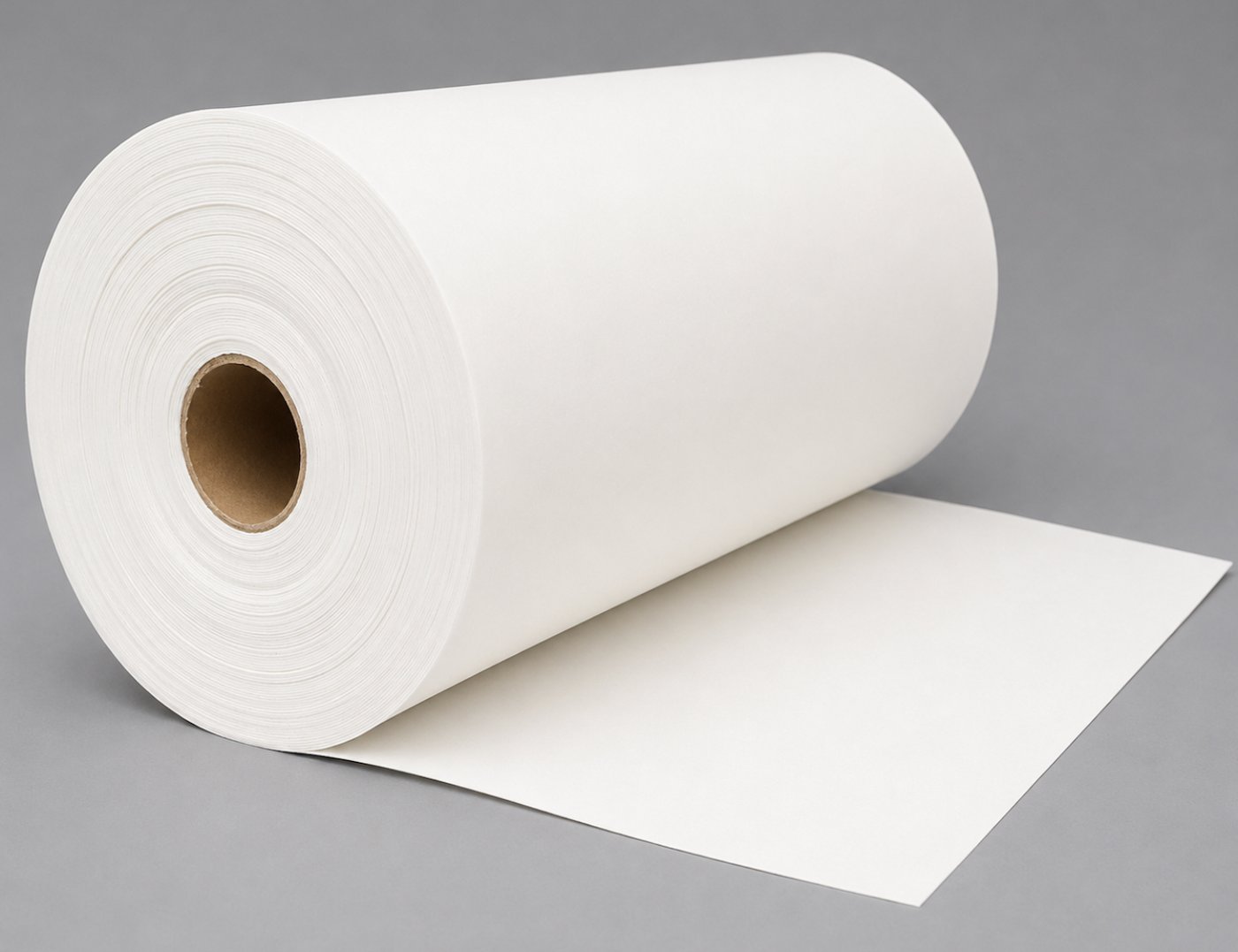
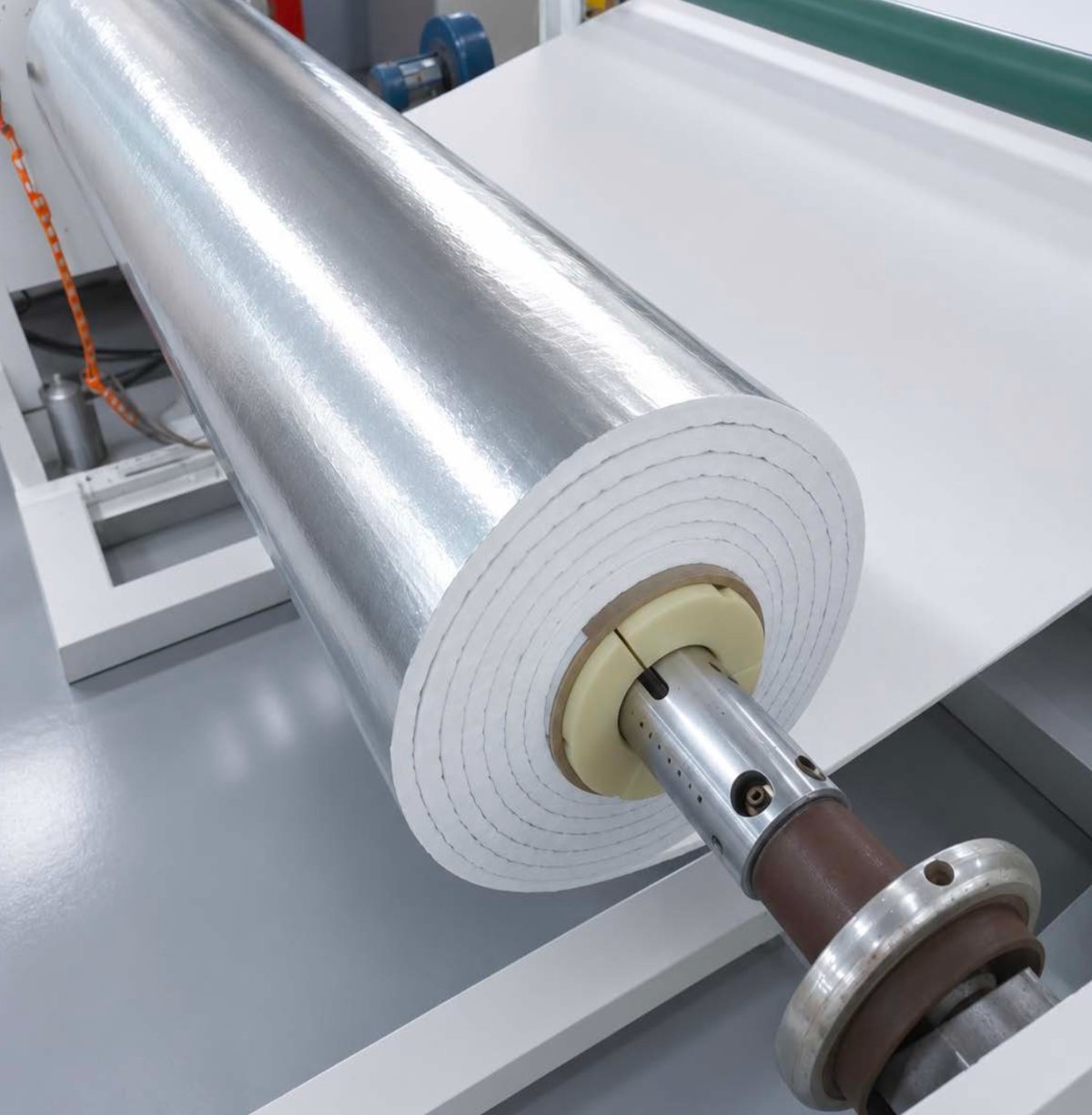
Silica aerogel grown into a glass-fibre, silica-cloth or PET mat, supplied in rolls 3 to 50 mm thick with a glass cloth, aluminium foil or PE facing. This is what refineries, EPCs and contractors buy by the square metre for pipes, vessels, tanks and ducts. It is flexible enough to wrap a 25 mm elbow, is cut with a utility knife, and is fixed with the same bands, pins and cladding as wool.
Aerogel board, panel and pad
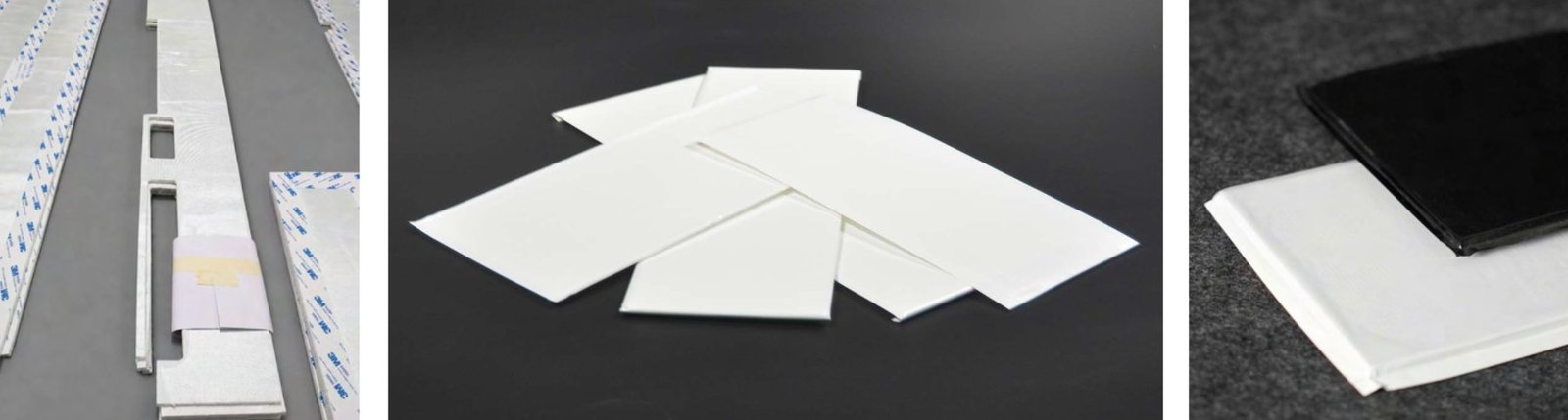
For flat surfaces and machine-made parts, aerogel is laminated into rigid panels or die-cut into pads. WedGel RP1000 rigid panels line furnace hot faces and kiln backing to 1,000 °C. Die-cut and self-adhesive pads go between EV battery cells and modules as thermal-runaway barriers, and laminated composite panels are made to drawing at the Faridabad works.
Aerogel paint, paste and jelly: the retail entry point
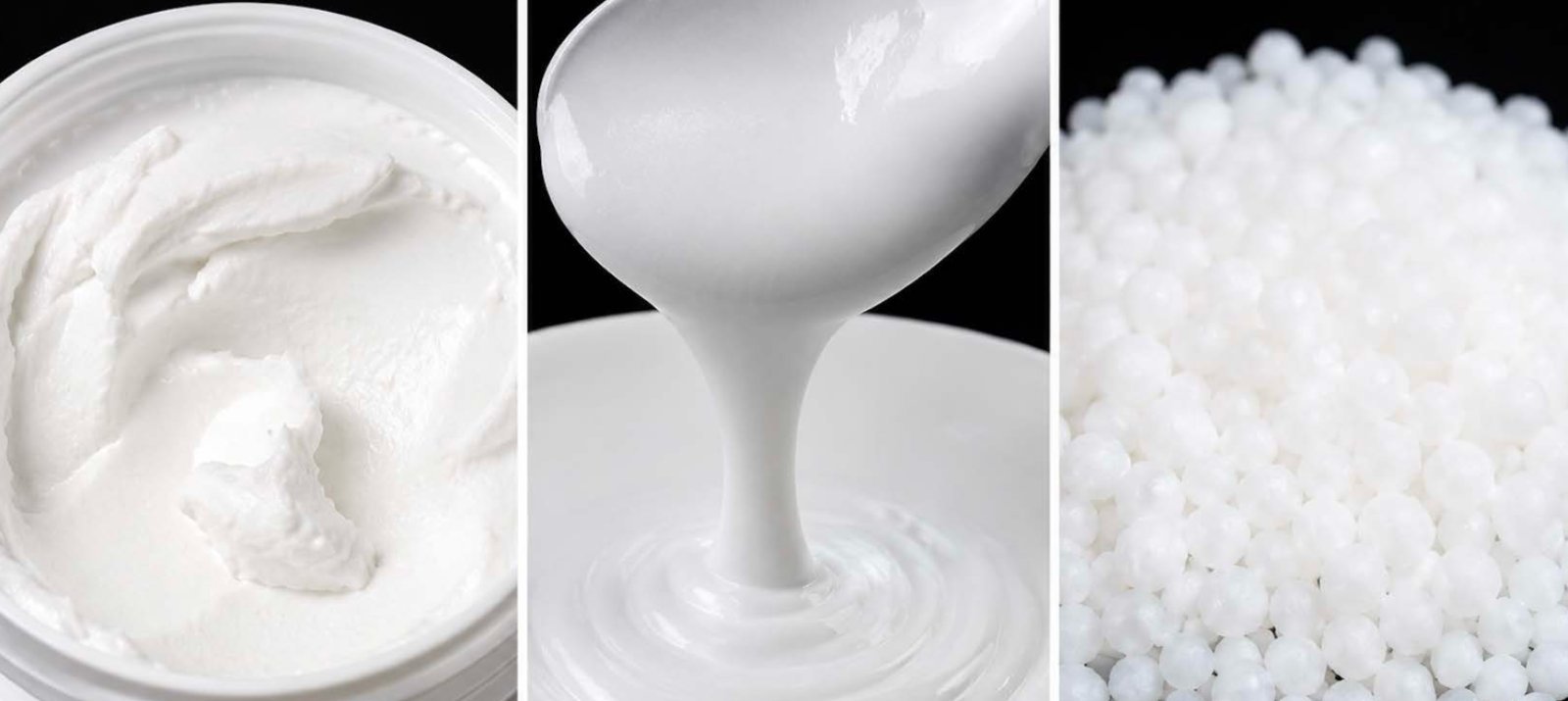
WedGel WJ120 is a water-based aerogel insulation paint for buildings (to 120 °C) and WJ400 is the industrial grade for hot equipment (to 400 °C). Both are applied by brush, spray or trowel at up to 0.5 mm wet film per coat, with a dry conductivity of 0.038 W/m·K. WJ-Paste fills flanges and valves; WJ-Jelly is pourable for refinery turnaround insulation. Paint is the easiest way to try aerogel on a single roof, tank or oven before committing to blanket.
Aerogel powder and granules
Hydrophobic silica aerogel powder (WAP20, WAP60, WAPM19) in 2 to 50 µm grades and AG beads in 1 to 6 mm are sold to paint, gypsum board and composite manufacturers as an additive. Conductivity is 0.016 to 0.023 W/m·K with porosity to 98%. Buyers of powder are usually formulators, not end users.
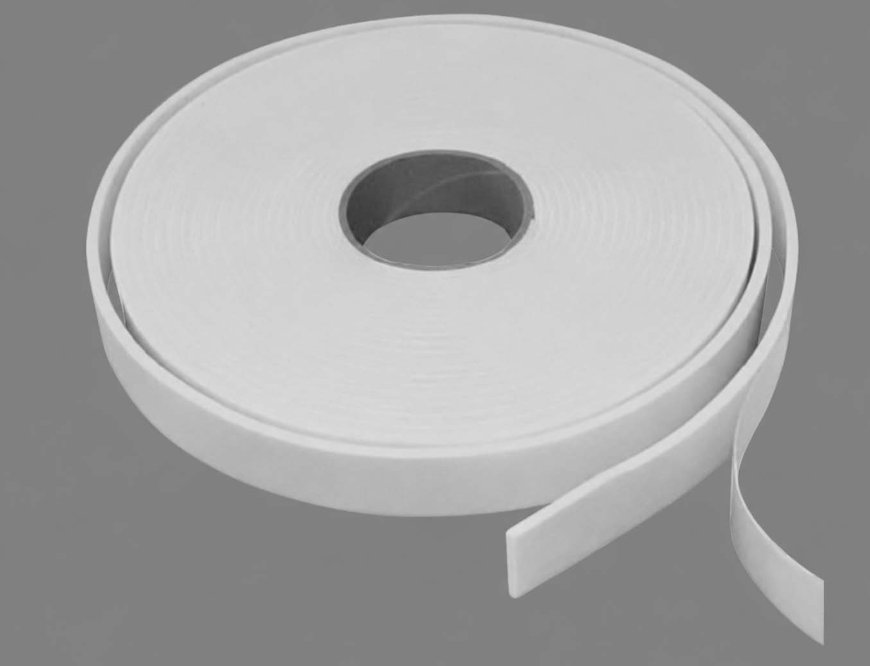
Aerogel tape
Narrow self-adhesive strips of aerogel blanket for pipe joints, flange gaps, window reveals and small-radius bends where a full roll is awkward. A useful companion to blanket on any installation.
Free download: WedGel Aerogel Insulation Catalogue 2026
14 pages covering every WedGel grade: cryogenic, high-temperature, building, carbon composite, powder, coatings and EV battery barriers, with full thermal conductivity tables (PDF, 2.8 MB).
What is aerogel used for? Applications by industry
| Industry | Application | WedGel grade | Why aerogel |
|---|---|---|---|
| Oil & gas, refining | Process pipes, reactors, heat exchangers to 650 °C | WAG650, 650HP | Thin, hydrophobic, resists corrosion under insulation |
| Petrochemical, chemical | Steam lines, reactors, jacketed vessels | WAG400, WAG650 | Fits congested racks; 10–15 day project supply |
| LNG, cryogenic | Tanks, cold boxes, LIN/LOX piping to −200 °C | 125A, 200, 200HP, 125A-M marine | Lowest λ in cryogenic service; passes ASTM C795 |
| Power, steel, foundry | Turbine cladding, furnace hot face, kiln backing | WAG650-VR, RP1000 | Vibration resistant; 1,000 °C rigid panel |
| EV and battery | Cell-to-cell and module barriers, BESS containers | 650EV, OXF, CAC350, AlSi 250EV | UL94 V-0, ≥10 kV/mm breakdown, 0.24 mm minimum |
| Buildings, façades | External walls, roofs, cold-bridge and fire partitions | BL20 (cold), BL50 (heat/fire) | High R per mm of wall depth; A1 non-combustible |
| HVAC, refrigeration, cold chain | Chilled water, ducts, refrigerated transport, shippers | 150AL foil-faced, 125LD, VIP | Foil vapour retarder; VIP down to 0.005 W/m·K |
| Industrial equipment, OEM | Ovens, dryers, genset exhausts, personnel protection | WAG400, WJ400 paint | 20 mm brings 150 °C skin below 40 °C |
Delhi NCR, with its furnace makers in Faridabad and the Manesar–Gurugram EV cluster, is where Wedge Industries Limited has won the most aerogel orders, followed by refinery and petrochemical sites across Gujarat and Maharashtra, and export projects in the UAE, Saudi Arabia and Qatar.
The WedGel aerogel range: technical data
All figures below are from the WedGel catalogue 2026 and are supplied with a full TDS and material test certificate on every order. Blankets are manufactured to ASTM C1728 and pass ASTM C795 stress-corrosion and C1617 corrosiveness tests.
| Grade | Service temp. | λ at 25 °C | λ at 200 °C | λ at 600 °C | Density | Thickness | Fire class |
|---|---|---|---|---|---|---|---|
| WAG400 | −50 / +400 °C | 0.018 | 0.026 | — | 180 kg/m³ | 3–20 mm | A1 |
| WAG650 | −50 / +650 °C | 0.018 | 0.028 | 0.068 | 200 ± 40 kg/m³ | 3–50 mm | A1 |
| 650HP | −10 / +650 °C | — | 0.028 | 0.062 | 200 kg/m³ | 5–20 mm | A1 |
| ECO | up to +650 °C | 0.029 | 0.049 | — | 170 ± 20 kg/m³ | 5–20 mm | A |
| Grade | Service temp. | λ at −129 °C | λ at 24 °C | Density | Thickness | Notes |
|---|---|---|---|---|---|---|
| 125A | −200 / +125 °C | 0.014 | 0.018 | 160 ± 30 kg/m³ | 10 mm | Silica cloth faced, LNG tanks |
| 125LD | −200 / +125 °C | 0.013 | 0.023 | 70 kg/m³ | 8–25 mm | Lightweight, ducts and cold chain |
| 125B | −180 / +125 °C | 0.015 | 0.021 | 185 kg/m³ | 5–20 mm | Cost-effective cold pipelines |
| 150AL | −195 / +150 °C | 0.015 | 0.021 | 160–200 kg/m³ | 5–20 mm | Aluminium foil vapour retarder |
| 200 / 200HP | −200 / +200 °C | 0.014 (HP) | 0.017 (HP) | 160–170 kg/m³ | 5–20 mm | LNG terminals |
| VIP | −100 / +80 °C | — | 0.005 | 200 ± 30 kg/m³ | 20–50 mm | Vacuum panel, cold chain |
| Grade | Form | Service temp. | λ at 25 °C | Fire | Use |
|---|---|---|---|---|---|
| BL20 | Blanket | −170 / +100 °C | 0.021 | A1 | Building cold envelope, façades |
| BL50 | Blanket | +25 / +1,200 °C | 0.021 | A | Building heat and fire envelope |
| CAC350 | Carbon-fibre felt | 350 °C (1,200 °C short-term) | 0.021 | UL94 V-0 | EV barriers, welding drapes, arc apparel |
| WJ120 | Paint | −40 / +120 °C | 0.038 | A2 | Building insulation paint |
| WJ400 | Paint | −40 / +400 °C | 0.038 | A | Industrial hot-surface coating |
| 650EV | Paper / pad | −50 / +700 °C | 0.018 | A1, V-0 | Cell-to-cell EV barrier, 0.24–10 mm |
| WAP20 | Powder | — | 0.016–0.018 | — | Coating and film additive, 15–50 µm |
Every WedGel blanket is hydrophobic to 99% or better, RoHS and REACH compliant, and shows less than 2% linear shrinkage after 24 hours at service temperature. Standard grades ship ex-stock from Faridabad in 24 to 48 hours; project quantities take 10 to 15 days. See the full WedGel aerogel range for individual product pages.
Is aerogel insulation fireproof and safe?
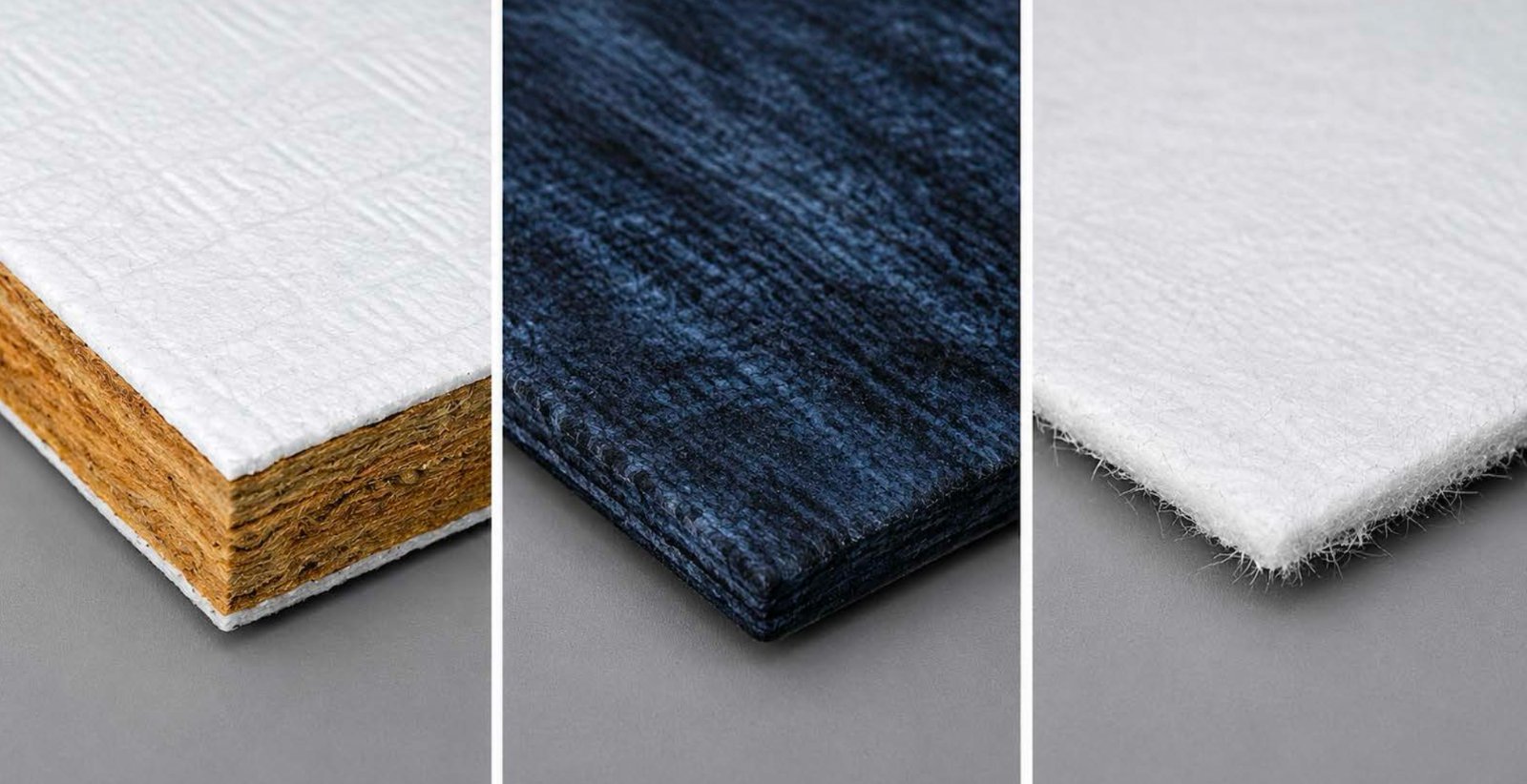
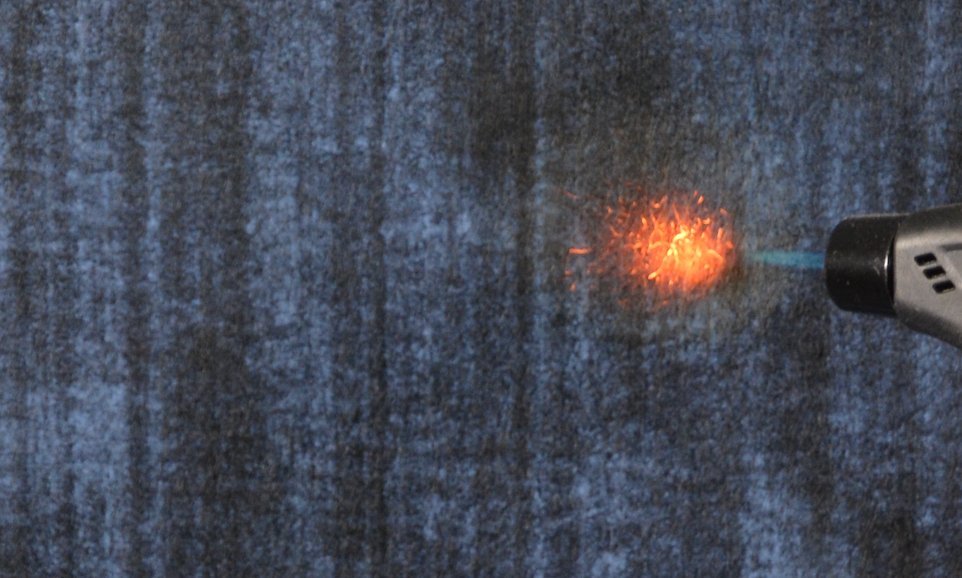
Silica aerogel is an inorganic mineral and does not burn. WedGel WAG400, WAG650, BL20 and the EV grades are Class A1 non-combustible to EN 13501-1 / ISO 1182; ECO, BL50 and CAC350 are Class A with ASTM E84 flame spread of 25 or less. In a direct blowtorch test, CAC350 carbon aerogel felt chars locally at the flame but does not ignite or carry the flame across the sheet, which is why it is used for EV thermal-runaway barriers and welding drapes.
On safety in handling: aerogel blanket releases a fine, inert silica dust when cut. It is not classified as hazardous, but it is drying to the skin, so gloves, a P2 dust mask, safety glasses and long sleeves are standard on site. There is no asbestos, no ceramic fibre and no halogen in any WedGel blanket grade. Full safety data sheets are supplied with the TDS.
Six myths about aerogel
- “Aerogel is a lab material.” It has been an ASTM-standard industrial insulation (C1728) for over fifteen years and is installed on refineries and LNG terminals worldwide. Wedge Industries Limited stocks it in Faridabad and Hardoi.
- “It is too fragile to install.” The monolith is fragile; the blanket is not. It wraps, bends and bands like wool and passes ASTM C1101 flexibility.
- “It is only for high temperatures.” The cryogenic grades work to −200 °C, and BL20 and the foil-faced 150AL are built for cold and HVAC duty.
- “It is always too expensive.” Per m² it costs more than wool; installed, on a congested line, it is often cheaper once cladding diameter, supports, labour hours and downtime are counted. The 2027 price guide shows the numbers.
- “It is waterproof, so cladding is optional.” The blanket is hydrophobic, but water still needs a sealed path to be kept out of joints and terminations. Cladding and sealing are still required.
- “All aerogel blankets are the same.” Carrier fibre, temperature grade, density and hydrophobicity differ widely. Ask for the TDS at your operating temperature and an MTC for the batch before you compare prices.
How to specify and buy aerogel in India
Give your supplier the operating temperature, ambient conditions, pipe size or surface area, target cold-face temperature, and any fire, vibration or chemical exposure. From that, Wedge Industries Limited selects the grade, runs the heat-loss and thickness calculation, and quotes per m² with the TDS, test standards and lead time. Small quantities can be bought online through the WedGel product pages; project quantities are quoted within 24 hours.
Compare every WedGel grade in one document
The 2026 catalogue has the full thermal conductivity tables at each temperature, densities, thicknesses and compliance data for all 30+ WedGel grades (PDF, 2.8 MB).
Frequently asked questions
What is aerogel insulation and how does it work?
Aerogel insulation is a silica gel that has had its liquid replaced by air, leaving a solid that is over 90% air held in pores a few nanometres wide. The pores are too small for air molecules to move freely, so heat cannot cross the material by convection or conduction. The result is a thermal conductivity of about 0.018 W/m·K at 25 °C, two to four times lower than mineral wool.
Is aerogel insulation fireproof and safe?
Silica aerogel is inorganic and non-combustible. WedGel WAG400, WAG650, BL20 and the EV grades are classified A1 to EN 13501-1 / ISO 1182; ECO, BL50 and CAC350 are Class A. ASTM E84 flame spread is 25 or less on all blanket grades. During cutting, aerogel dust is inert but drying to skin, so gloves, a dust mask and long sleeves are recommended. It contains no asbestos, no halogens and is RoHS and REACH compliant.
Aerogel vs fibreglass vs rockwool: which is better?
At the same heat loss, 10 mm of WedGel WAG650 aerogel does the work of about 45 mm of fibreglass or 60 mm of mineral wool. Aerogel is hydrophobic, so it keeps insulating when wet, and it fits where wool cannot. Fibreglass and rockwool cost less per square metre and are the better choice on large, open surfaces with plenty of space. See our aerogel price guide for the full cost comparison.
What is aerogel used for?
Aerogel is used on refinery and petrochemical process pipes, steam lines, LNG and cryogenic tanks, EV battery packs (as thermal-runaway barriers), industrial ovens and exhausts, building façades and roofs where wall depth is limited, cold-chain boxes, and as a powder additive in insulating paints and coatings.
Is aerogel waterproof?
Silica aerogel blankets are hydrophobic. WedGel grades show 99% or better water repellency, with water absorption below 5% on the building grades. They are not vapour barriers: water can still travel through gaps in the cladding, so joints and terminations must be sealed. Because the blanket sheds water, it dries out and recovers its performance rather than staying wet like mineral wool.
What is the difference between aerogel blanket, board, paint and powder?
Blanket is silica aerogel on a flexible fibre carrier, sold in rolls of 3 to 50 mm, and is the main industrial product. Boards and laminated panels are rigid versions for furnace linings, EV packs and building envelopes. Paint (WJ120 and WJ400) is a water-based coating filled with aerogel powder, applied by brush or spray to 120 °C or 400 °C surfaces. Powder and granules are the raw material sold as an additive for coatings, gypsum and composites.
How thick should aerogel insulation be?
For most hot process pipes between 150 °C and 400 °C, 10 to 20 mm of WedGel WAG400 or WAG650 keeps the cladding surface below 60 °C. Cryogenic lines usually take 20 to 40 mm in two layers. Building façades use 10 to 25 mm of BL20. Send your line temperature, pipe size and ambient conditions on WhatsApp and Wedge Industries Limited will run the heat-loss calculation for you.
Talk to an insulation engineer. Send your application, operating temperature and area on WhatsApp (+91 97175 06848) for the right WedGel grade, a thickness recommendation and the technical data sheet, or send an RFQ.
Technical values are typical figures from the WedGel catalogue 2026 and individual product TDS; confirm the grade-specific TDS and MTC for design. Wedge Industries Limited, Faridabad and Gurugram, exports to 45+ countries.