
Aerogel: What It Is, What It Costs and Where to Buy It in India
Aerogel is the lightest solid insulation material made, a silica network that is more than 90% air with a thermal conductivity of 0.018 W/m·K. Wedge Industries Limited manufactures WedGel aerogel blankets, pads, boards, granules, powder and coatings in India, with over ₹1 crore of blanket in ready stock. Price from ₹1,350 per m² ($14), about ₹1,400–₹2,200 per kg ($15–$23).
What is aerogel?
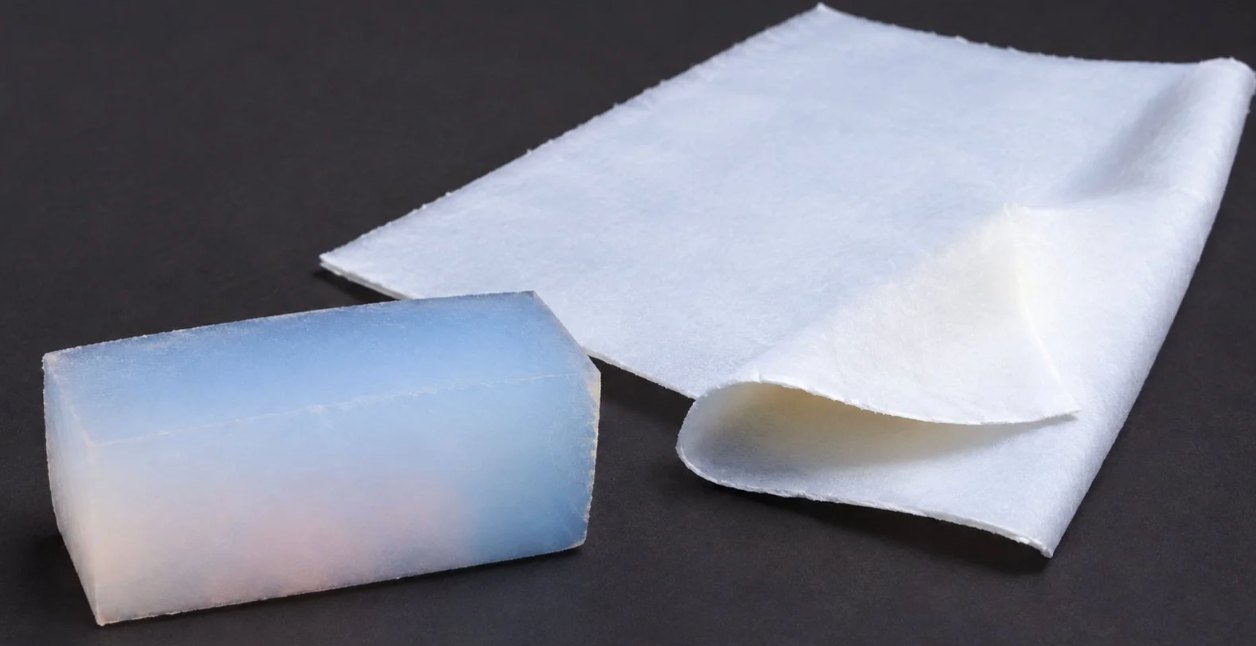
Aerogel is a synthetic, ultra-porous solid in which the liquid of a gel has been replaced by gas without the structure collapsing. The result is a material that is more than 90% air by volume, so light that it is nicknamed “frozen smoke”, and yet a better thermal insulator than still air itself. Silica aerogel, the type used in industry, has a thermal conductivity of 0.018 W/m·K at 25 °C, about half that of mineral wool.
ASTM C168 defines an aerogel as a homogeneous, low-density solid derived from a gel, in which the liquid component has been replaced with a gas, leaving a porous structure with an average pore size below the mean free path of air molecules. That last clause is the whole secret: air molecules trapped in 20–50 nanometre pores cannot move far enough to carry heat by convection or collide often enough to carry it by conduction (the Knudsen effect). The solid silica skeleton is so thin and tortuous that it conducts very little heat either.
Aerogel was first made in 1931 by the American chemist Samuel Kistler, who proved that the liquid in a gel could be removed without shrinking it. For decades it stayed a laboratory curiosity; NASA used it to capture comet dust and to insulate the Mars rovers. Since the 2000s, flexible aerogel insulation blankets have made it a routine industrial product, and today Wedge Industries Limited manufactures it in India for pipelines, LNG, buildings and EV batteries.
What is aerogel made of?
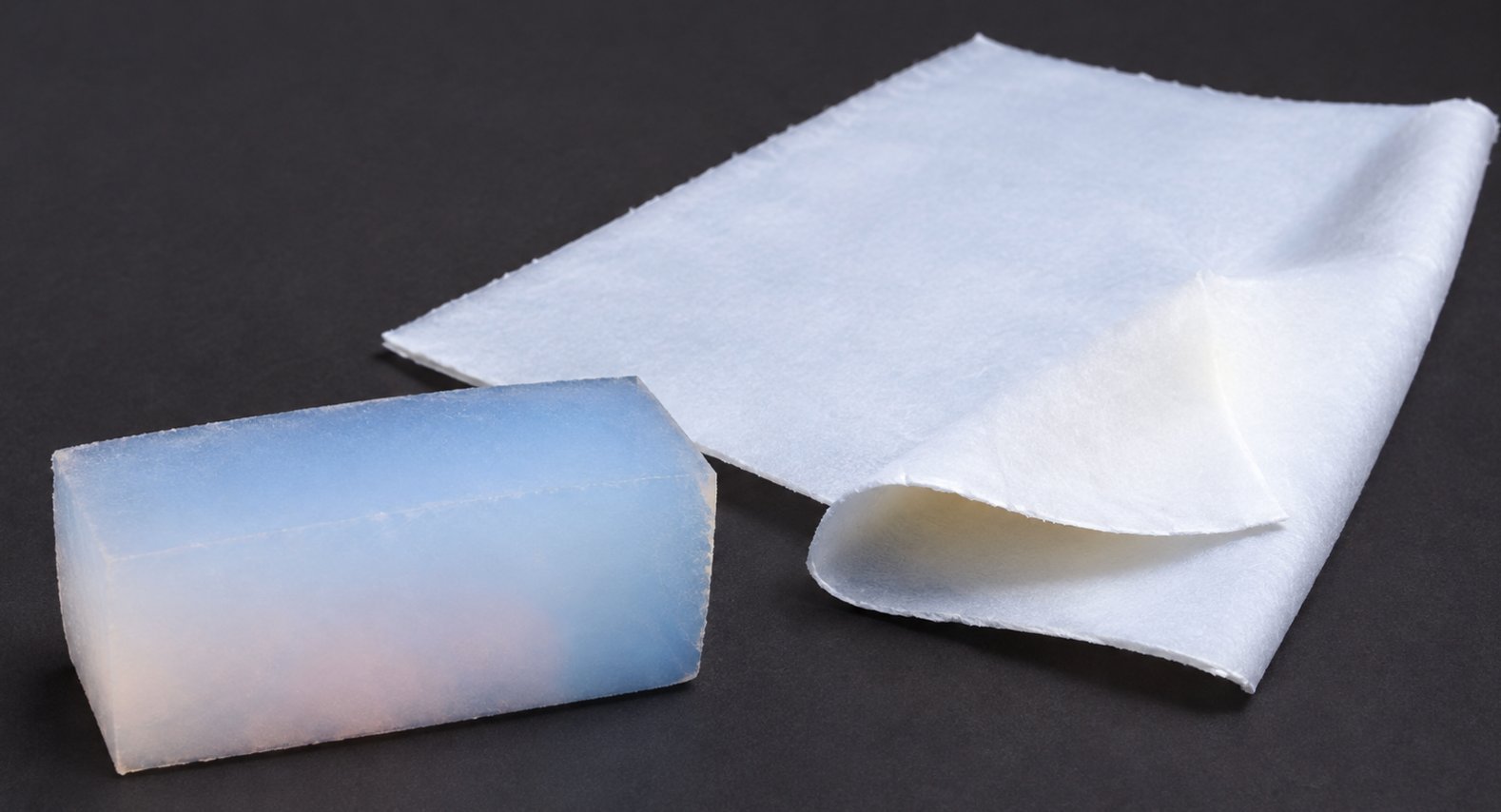
Most commercial aerogel is silica aerogel, made from silicon dioxide (SiO₂), the same chemistry as glass and sand. The silica is arranged as a three-dimensional network of nanoparticles joined into strands, with air filling the open space between them. Industrial aerogel insulation adds a reinforcing carrier, usually glass-fibre, ceramic-fibre or PET non-woven, to give the brittle silica flexibility, and a hydrophobic surface treatment so it repels water.
| Type of aerogel | Made of | Typical thermal conductivity | Where it is used |
|---|---|---|---|
| Silica aerogel | SiO₂ network from sodium silicate or silicon alkoxide precursors; glass-fibre or ceramic-fibre carrier | 0.015–0.023 W/m·K | Pipe, tank, LNG, building and EV insulation; the WedGel blanket, felt, pad, board, granule and powder range |
| Carbon aerogel | Pyrolysed organic (resorcinol-formaldehyde) gel, often carbon-fibre reinforced | 0.021 W/m·K (composite) | EV cell-to-cell barriers, aerospace, electrodes; WedGel CAC350 |
| Polymer aerogel | Polyimide, polyurea, cellulose or other organic gels | 0.020–0.030 W/m·K | Flexible films, aerospace, acoustic parts |
| Metal-oxide aerogel | Alumina, titania, zirconia gels | 0.03–0.1 W/m·K | Catalysts, very high temperature research |
Values are typical published ranges. Wedge Industries Limited supplies silica aerogel in every form and carbon aerogel composite for EV battery packs; polymer and metal-oxide aerogels are not sold as insulation products.
How is aerogel made?
Aerogel is produced by the sol-gel process followed by a drying step that removes the liquid without letting surface tension crush the pores.
The drying step is what makes aerogel more expensive than foam or wool. Ambient-pressure drying and continuous blanket casting lines, like those used for the WedGel range, have brought the price of blanket down to ₹1,350–₹4,500 per m², within reach of ordinary industrial projects.
Aerogel properties
| Property | Silica aerogel (WedGel blanket) | Why it matters |
|---|---|---|
| Thermal conductivity at 25 °C | 0.018 W/m·K (0.015–0.023 across grades); 0.068 W/m·K at 600 °C | 2–3× thinner than mineral wool for the same heat loss |
| Density | Monolith 3–150 kg/m³; blanket 150–200 kg/m³; powder 20–100 kg/m³ | Light to handle, low load on pipe supports |
| Porosity and pore size | >90% air; pores 20–50 nm, below the 70 nm mean free path of air | Suppresses convection and gas conduction |
| Surface area | 600–800 m²/g | Exceptional adsorption and acoustic damping |
| Service temperature | −200 °C to +650 °C flexible; up to 1,000 °C rigid panel; 1,200 °C short-term fire-rated grades | One material family from LNG to furnaces |
| Fire performance | Non-combustible silica; Class A to ASTM E84, EN 13501-1 A/A1, ISO 1182; EV pads UL94 V0 | Passive fire protection and battery barriers |
| Water repellency | >99% hydrophobic (GB/T 10299), yet vapour-permeable | Stays dry, limits corrosion under insulation |
| Appearance | Translucent blue monolith (Rayleigh scattering); white, grey or black blanket depending on carrier | The “frozen smoke” look of a pure block |
| Sound | Low sound velocity, high damping | Acoustic pads for rail, metro, HVAC |
| Compressive behaviour | Pure monolith is brittle; fibre-reinforced blanket is flexible and recovers after compression | Blankets wrap bends, flanges and valves |
WedGel values are from the WedGel technical data sheets, tested to ASTM C1728 (flexible aerogel blanket) and ASTM C177. Pure-monolith figures are published laboratory ranges.
How much does aerogel cost?
Industrial aerogel blanket costs ₹1,350–₹4,500 per m² ($14–$47) in India for project quantities, which works out to roughly ₹1,400–₹2,200 per kg ($15–$23). A 5 mm ambient-grade blanket starts at about ₹1,350/m²; a 10 mm 650 °C grade is ₹2,950–₹3,850/m². Prices are ex-works Faridabad, exclude 18% GST, and were updated 01-10-2026 at ₹96 per US$.
| Aerogel form | How it is sold | Indicative price (India, project quantity) |
|---|---|---|
| Blanket 5 mm, up to 400 °C | per m², rolls of 10–20 m | ₹1,350–1,750 ($14–18) |
| Blanket 6 mm, up to 400 °C | per m² | ₹1,550–2,000 ($16–21) |
| Blanket 10 mm, up to 400 °C | per m² | ₹2,450–3,150 ($26–33) |
| Blanket 10 mm, 650 °C grade | per m² | ₹2,950–3,850 ($31–40) |
| Blanket 15–20 mm and speciality grades | per m² | up to ₹4,500 ($47) |
| Blanket, per kg equivalent | 180–200 kg/m³, so 10 mm ≈ 1.8–2.0 kg/m² | ≈ ₹1,400–2,200 per kg ($15–23) |
| Granules, powder, pads, boards, paints, VIP | per kg, per piece, per litre or per panel | Quoted per enquiry: get a price |
Sample orders under 20 m² cost 20–30% more; orders above 1,000 m² are priced on request. The four things that move the price are thickness, temperature grade, facing (foil, PET or silica cloth) and quantity. Full tier-by-tier breakdown, roll prices and a worked example: aerogel price in India. Installed-cost comparison and cost per pipe metre: aerogel cost.
Why “aerogel price per gram” is misleading
Search results and marketplaces quote small decorative aerogel pieces at a few hundred to a few thousand rupees for a few grams, which implies ₹50,000 or more per kilogram. Those are laboratory monoliths sold as curiosities, hand-made in small batches with supercritical drying. Industrial aerogel blanket is a continuous-line product sold by area, and its real cost is about ₹1.40–₹2.20 per gram. If you need aerogel for insulation, buy blanket by the square metre, not powder or blocks by the gram.
What is aerogel used for?
Aerogel is used wherever heat must be kept in or out and there is no room, weight budget or tolerance for wet insulation. The main uses today:
Pipe and equipment insulation
Steam, hot oil and process lines up to 650 °C in refineries, petrochemical and power plants. 10 mm of aerogel replaces 25–30 mm of mineral wool and stays dry, which controls corrosion under insulation.
LNG and cryogenic
LNG terminals, carriers and −200 °C pipelines, using cryogenic grades 125A, 200 and 200HP that do not crack or absorb moisture at low temperature.
EV batteries and BESS
Thin aerogel pads between lithium-ion cells stop thermal runaway propagating; grades withstand 1,400 °C flame and meet UL94 V0.
Buildings and prefab
Thin wall, roof and window-reveal insulation, aerogel paints and cavity-fill granules where a thick layer would eat floor area.
Cold chain and cold storage
Aerogel vacuum insulation panels at 0.005 W/m·K for reefer boxes, pharma shippers and cold rooms.
Passive fire protection
Non-combustible aerogel blankets around structural steel, cable routes and refinery assets.
Furnaces and kilns
Rigid aerogel panels behind refractory for steel furnace hot faces and kiln backing up to 1,000 °C.
Rail, metro, automotive, aerospace
Thin thermal and acoustic insulation in train cars, bus exhausts, aircraft and spacecraft, the original NASA use.
Apparel, paints and OEM additives
Aerogel powder and granules go into insulating paints, films, outdoor clothing, footwear and composites.
Forms of aerogel you can buy
Pure aerogel monoliths are too brittle for site use, so aerogel is sold in forms that combine the nanoporous silica with a carrier. Wedge Industries Limited stocks all of them.
| Form | Description | Thickness / size | Typical use |
|---|---|---|---|
| Aerogel blanket | Silica aerogel in glass-fibre or ceramic-fibre mat; plain, foil, PET or silica-cloth faced | 3–20 mm standard (1–50 mm range), rolls 10–20 m | Pipes, tanks, vessels, LNG, buildings |
| Aerogel felt / sheet | Thin dense sheet, up to 650 °C | 3–10 mm | Heat shields, mattresses, cassettes |
| Aerogel pad | Die-cut, film-encapsulated or adhesive-backed pieces | from 0.7 mm; any shape | EV and BESS cell barriers, refrigerators, tanks |
| Aerogel board / panel | Rigid pressed panel | 15–50 mm | Furnace hot face, kiln backing to 1,000 °C |
| Aerogel granules | Translucent beads, 0.019 W/m·K | 1–6 mm | Cavity fill, gypsum, plaster, daylighting panels |
| Aerogel powder | Hydrophobic silica aerogel, 20–100 kg/m³ | 15–50 µm (from 2 µm) | Paints, coatings, films, composites |
| Aerogel paint and coating | Water-based paint (0.030 W/m·K) and industrial coating to 400 °C | brush or spray coats up to 10 mm | Roofs, walls, hot equipment, personnel protection |
| Aerogel paste | Trowel-applied, up to 650 °C | up to 25 mm | Flanges, valves, irregular shapes |
| Aerogel VIP | Aerogel core vacuum panel, 0.005 W/m·K | 20–50 mm | Cold chain, ultra-low-energy buildings |

Choosing between grades? The full 25-grade table with service temperature, density and conductivity is on the aerogel insulation page, and the aerogel product selector matches a grade to your temperature.
Is aerogel expensive?
Per square metre, yes: aerogel blanket costs 3–5 times more than mineral wool of the same thickness. Per installed job, often no. Because aerogel needs 2–3 times less thickness, you buy less cladding, smaller pipe supports and fewer layers, and the hydrophobic blanket does not have to be ripped out after the first monsoon. On a 300 °C steam line, a 10 mm aerogel wrap typically replaces 30 mm of rock wool, and the extra material cost is recovered from fuel savings in one to three years. Where space is unlimited and the pipe is dry, mineral wool remains cheaper; where it is not, aerogel is usually the lower-cost system.
| Property | Aerogel blanket | Mineral / rock wool | PUF / PIR | Calcium silicate board |
|---|---|---|---|---|
| Thermal conductivity at 25 °C (W/m·K) | 0.018 | 0.033–0.040 | 0.022–0.028 | 0.050–0.060 |
| Maximum service temperature | 650 °C (1,000 °C panel) | 650–750 °C | 110–130 °C | 650–1,000 °C |
| Cryogenic use | Yes, to −200 °C | Limited | to about −50 °C | No |
| Thickness for the same heat loss | 1× | 2–2.5× | 1.3–1.5× (low temperature only) | about 3× |
| Water uptake | Hydrophobic, 99% repellency | Absorbs unless treated | Low | Absorbs |
Competing-material values are typical published ranges. Wedge Industries Limited also supplies calcium silicate boards, microporous insulation, ceramic fibre blanket and spray foam where they suit the job better.
Aerogel in India: manufacturer, stock and delivery
Buy aerogel online
The most-ordered WedGel grades are below; every product page carries the data sheet values and a quote button. Need help choosing? Send your operating temperature and quantity by WhatsApp and an engineer will reply within one working day.
-
Aerogel Insulation
WedGel WAG650 Commercial Grade Aerogel Blanket up to 650°C
Contact for Price 📩 Contact for Price -
Aerogel Insulation
WedGel WAG400 Low Cost Aerogel Blanket for Process Pipes (up to 400°C)
Contact for Price 📩 Contact for Price -
Aerogel Insulation
WedGel 200 Standard Cryogenic Aerogel Blanket — -200 to +200 °C Service
Contact for Price 📩 Contact for Price -
Aerogel Insulation
WedGel ECO Cost Optimised Aerogel Blanket up to 650°C
Contact for Price 📩 Contact for Price -

WedGel RP1000 Rigid Aerogel Panel for Steel Furnace Hot Face & Kiln Backing (up to 1000°C)
Read moreAerogel InsulationWedGel RP1000 Rigid Aerogel Panel for Steel Furnace Hot Face & Kiln Backing (up to 1000°C)
Contact for Price 📩 Contact for Price -
Aerogel Insulation
WedGel AG Aerogel Bead Granules for Cavity Fill, Gypsum & Building Insulation (1–6 mm)
Contact for Price 📩 Contact for Price -
Aerogel Insulation
WedGel WAP20 Hydrophobic Aerogel Powder — Coatings, Paint & Film Additive (15–50 µm)
Contact for Price 📩 Contact for Price -
Aerogel Insulation
WedGel CAC350 Carbon Aerogel Composite — Premium EV Thermal Runaway Barrier
Contact for Price 📩 Contact for Price -
Aerogel Insulation
WedGel 650HP Silica Cloth Premium Aerogel Blanket for HP Steam & Turbines
Contact for Price 📩 Contact for Price




View all 53 aerogel products →
Guides and tools
- Aerogel insulation: the 25-grade WedGel selector, standards and applications.
- Aerogel price in India (2027): per m², per roll and per kg, with price tiers.
- Aerogel cost: cost per pipe metre, installed cost vs mineral wool, and when it pays back.
- Silica aerogel: chemistry, properties, types and how it is made.
- What is aerogel insulation?: the complete guide to blankets, boards and paint.
- Aerogel for BESS and best thermal insulation for BESS.
- Insulation thickness calculator and how to calculate insulation thickness.
- Aerogel product selector: match a grade to your temperature and application.
Aerogel FAQs
How much does aerogel cost?
Industrial aerogel blanket costs ₹1,350–₹4,500 per m² ($14–$47) in India for project orders of 100 m² and above, ex-works Faridabad, excluding 18% GST. A 5 mm blanket for up to 400 °C starts at about ₹1,350/m²; a 10 mm 650 °C grade is ₹2,950–₹3,850/m². Powder, granules, pads, boards and paints are quoted per enquiry.
How much is 1 kg of aerogel?
Aerogel blanket works out to roughly ₹1,400–₹2,200 per kg ($15–$23) because a 10 mm blanket at 180–200 kg/m³ weighs about 1.8–2.0 kg per m². Aerogel is sold by area, not weight, so ask for a per-m² price. Per-kg figures seen online usually refer to aerogel powder or granules, a different product that Wedge Industries Limited also supplies on request.
How much does 1 gram of aerogel cost?
About ₹1.40–₹2.20 per gram in blanket form at industrial quantities. Small decorative aerogel blocks sold online for a few hundred to a few thousand rupees per piece are laboratory monoliths, and their per-gram price is 20–50 times higher than industrial aerogel. Nobody insulates with aerogel bought by the gram.
What is aerogel used for?
Thermal insulation of pipes, tanks and equipment from −200 °C to +650 °C in oil and gas, LNG, petrochemical and power plants; thermal-runaway barriers in EV and BESS battery packs; thin building, roof and window insulation; cold-chain vacuum panels; passive fire protection; furnace and kiln backing; rail, automotive and aerospace parts; and as a powder additive in insulating paints, films and clothing.
What is aerogel made of?
Commercial aerogel is silica (silicon dioxide), the chemistry of glass and sand, formed into a nanoporous network that is more than 90% air. Industrial aerogel blanket adds a glass-fibre or ceramic-fibre carrier for flexibility and a hydrophobic silane surface treatment. Carbon, polymer and metal-oxide aerogels exist for speciality uses; Wedge Industries Limited supplies silica aerogel and carbon aerogel composite.
What is silica aerogel?
Silica aerogel is aerogel whose solid skeleton is amorphous silicon dioxide, made by the sol-gel process from sodium silicate or silicon alkoxides and dried without pore collapse. It has the lowest thermal conductivity of any solid insulation (0.015–0.023 W/m·K), is non-combustible, withstands 650 °C, and is the type used in all WedGel blankets, felts, pads, boards, granules and powders.
Is aerogel expensive?
Per square metre, aerogel blanket costs 3–5 times more than mineral wool of the same thickness. Per installed job it is often cheaper, because it needs 2–3 times less thickness, less cladding and smaller supports, and it does not absorb water. On hot process lines the extra material cost is usually recovered from fuel savings within one to three years.
Why is aerogel called frozen smoke?
A pure silica aerogel monolith is translucent with a faint blue haze, caused by Rayleigh scattering of light in its nanometre-scale pores, so a block looks like a piece of solidified smoke. It is also one of the lightest solids known: laboratory aerogels can be 3 kg/m³, only about three times the density of air.
Is aerogel safe to handle?
Silica aerogel is non-toxic and chemically inert. Cutting blanket releases fine amorphous silica dust and loose fibre, so wear gloves, a dust mask and eye protection, and cut with a sharp knife rather than abrasive tools. Amorphous silica is not classified as a carcinogen, unlike crystalline silica. Material safety data sheets are available for every WedGel grade.
Is aerogel waterproof and fireproof?
WedGel aerogel blankets are over 99% hydrophobic (GB/T 10299) while staying vapour-permeable, so water runs off and trapped moisture can escape. Silica aerogel is inorganic and non-combustible: blankets are Class A to ASTM E84 and EN 13501-1 and tested to ISO 1182, and EV grades meet UL94 V0. Fire performance depends on the carrier and facing, so check the TDS of the grade you specify.
What temperature can aerogel withstand?
Flexible WedGel blankets are rated from −200 °C (cryogenic grades 125A, 200, 200HP) to +650 °C (WAG650, 650HP). The RP1000 rigid panel is rated to 1,000 °C, the BL50 fire-rated building blanket to 1,200 °C short-term, and the WAG 650EV battery pad withstands 1,400 °C flame exposure.
Who invented aerogel, and does NASA use it?
Samuel Kistler made the first aerogel in 1931 at the College of the Pacific, California. NASA used silica aerogel on the Stardust mission to capture comet particles and to insulate the Mars rover electronics. Those uses made aerogel famous; the flexible blanket, developed in the 2000s, made it a practical industrial insulation.
Can I buy aerogel on Amazon or in small quantities?
Marketplaces list small aerogel blocks and tiles as curiosities at retail prices. For insulation, order from Wedge Industries Limited: sample cuts under 20 m² are available at sample pricing, full rolls of 10–20 m from ready stock, and pads or powder in trial quantities. Order online from the aerogel store or WhatsApp +91 97175 06848.
What is the difference between aerogel and aerogel insulation?
Aerogel is the material: a nanoporous solid, usually silica, that is mostly air. Aerogel insulation is the product made from it: silica aerogel bonded into a fibre blanket, felt, pad or board, or dispersed in a paint or paste, so it can be installed on pipes, tanks, buildings and batteries. See the aerogel insulation page for grades and specifications.
How long does aerogel insulation last?
Silica aerogel is inorganic and does not degrade, outgas or settle, and its hydrophobic treatment is stable across the rated temperature range. Properly clad WedGel blanket is expected to serve for the life of the plant, typically 20 years or more, with no loss of thermal performance, where mineral wool often needs replacement after water ingress.
Where can I buy aerogel in India?
Directly from Wedge Industries Limited, the manufacturer: order online at wedgeinsulation.com, call or WhatsApp +91 97175 06848, or use the enquiry form. Ready stock is held in Faridabad and delivered across India, with city pages for Delhi NCR, Mumbai, Pune, Ahmedabad, Bangalore, Chennai, Kolkata and Lucknow. Export orders to the Gulf, UK and USA are quoted in USD.
Get an aerogel price in 24 hours
Send your operating temperature, pipe sizes or area in m², and quantity. Our engineers will recommend the form, grade and thickness and send a price in INR or USD.
Last updated 02-10-2026 by the Wedge Industries Limited technical team.