
Spray Foam Insulation in India – Closed-Cell PUF, Supplied & Applied
Wedge Industries Limited applies closed-cell spray foam insulation (spray polyurethane foam / PUF) with its own crew and supplies SPF chemical drum sets to applicators. λ 0.020–0.023 W/m·K, over 90% closed cell, from ₹970/m² (₹90/sq ft) applied at 50 mm — one seamless layer that insulates, air-seals and stops roof condensation.
Browse spray foam products · Spray foam insulation price guide 2026
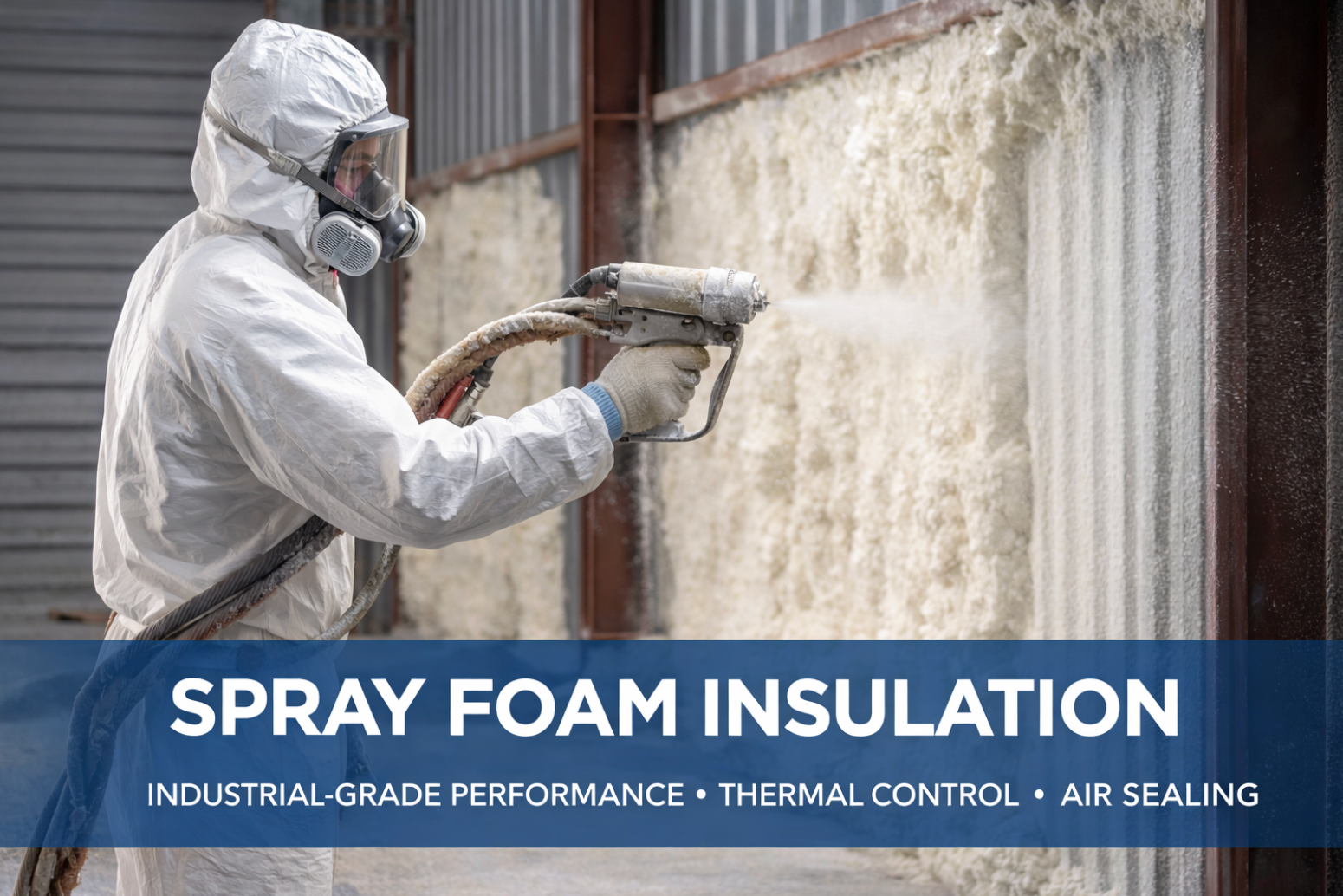
What is spray foam insulation?
Spray foam insulation is a two-component polyurethane (polyol + isocyanate) that is mixed at the spray gun, expands on contact and cures within seconds into a rigid, closed-cell foam bonded to the surface. Because it is sprayed rather than fixed in boards, it leaves no joints, fills every gap around purlins, bolts and corrugations, and forms a continuous air and vapour barrier in the same pass. Closed-cell spray foam insulation has the highest thermal resistance per millimetre of any commonly specified building insulation in India — which is why it is the fastest way to insulate an existing metal roof, cold room or terrace without dismantling anything.
In India it is also called PUF spray insulation, polyurethane foam spray or SPF (spray polyurethane foam). Wedge uses water-blown closed-cell systems only; open-cell foam is not suited to India’s humid climate or to cold-chain work.
Spray foam insulation specifications
| Property | Wedge closed-cell spray foam insulation |
|---|---|
| Foam type | Closed-cell rigid polyurethane, water-blown, 2-component, 1:1 by volume |
| Thermal conductivity (initial) | 0.020–0.023 W/m·K |
| Closed-cell content | > 90% |
| Sprayed in-place density | 35–38 kg/m³ |
| Compressive strength | 276 kPa parallel / 166 kPa perpendicular |
| Fire behaviour | UL 94 HF-1, FMVSS 302 (system dependent; certificate supplied with the system used) |
| Applied thickness | 50 / 80 / 100 mm standard; 20–55 mm per pass, multi-pass above 55 mm |
| Chemical consumption | 2.13 kg/m² at 50 mm including 12% wastage |
| Substrate temperature | 21–43 °C (flash coat below 21 °C) |
| Service temperature | Not continuously above 107 °C |
| Minimum order (applied) | 200 m² |
Values are from the system product data sheets. A thickness map and density coupon records are issued with every applied job.
Spray foam insulation price in India
| Applied thickness | ₹ per m² | ₹ per sq ft | $ per m² | Typical use |
|---|---|---|---|---|
| 50 mm | ₹970–1,025 | ₹90–95 | $10.1–10.7 | Warehouse and factory roofs, PEB sheds, poultry sheds, terraces |
| 80 mm | ₹1,420–1,500 | ₹132–139 | $14.8–15.7 | Cold rooms, chillers, high temperature-difference walls |
| 100 mm | ₹1,720–1,820 | ₹160–169 | $18.0–19.0 | Deep-freeze rooms, blast freezers, cold chain |
Indicative rates for supply and application, excluding 18% GST, confirmed after site survey. Chemical prices move with feedstock and exchange rates. See the full spray foam insulation price guide for what drives cost.
Spray foam insulation products and services
Applied on site (50 / 80 / 100 mm)
From ₹970/m²
Supply and application by Wedge’s own certified crew, with thickness mapping and density records. Delhi NCR direct; pan-India via partners.
SPF drum sets – imported spec grade
Matched polyol + isocyanate sets for applicators on Graco E-20-class rigs. 188–207 m² per set at 50 mm.
SPF drum sets – local fast-supply
Blended in India with imported pMDI, supplied ex Greater Noida for same-week replenishment.
Spray foam insulation in Delhi NCR
Warehouses, cold stores, PEB sheds and factory roofs across Delhi, Gurugram, Noida, Faridabad and Bhiwadi — no mobilisation surcharge inside NCR.
Spray foam insulation in Lucknow
Roof and cold-store spray foam for Lucknow and the wider Uttar Pradesh region.
Spray foam water tank insulation
Seamless PUF with UV topcoat, 25–75 mm, for rooftop, RCC and irregular tanks.
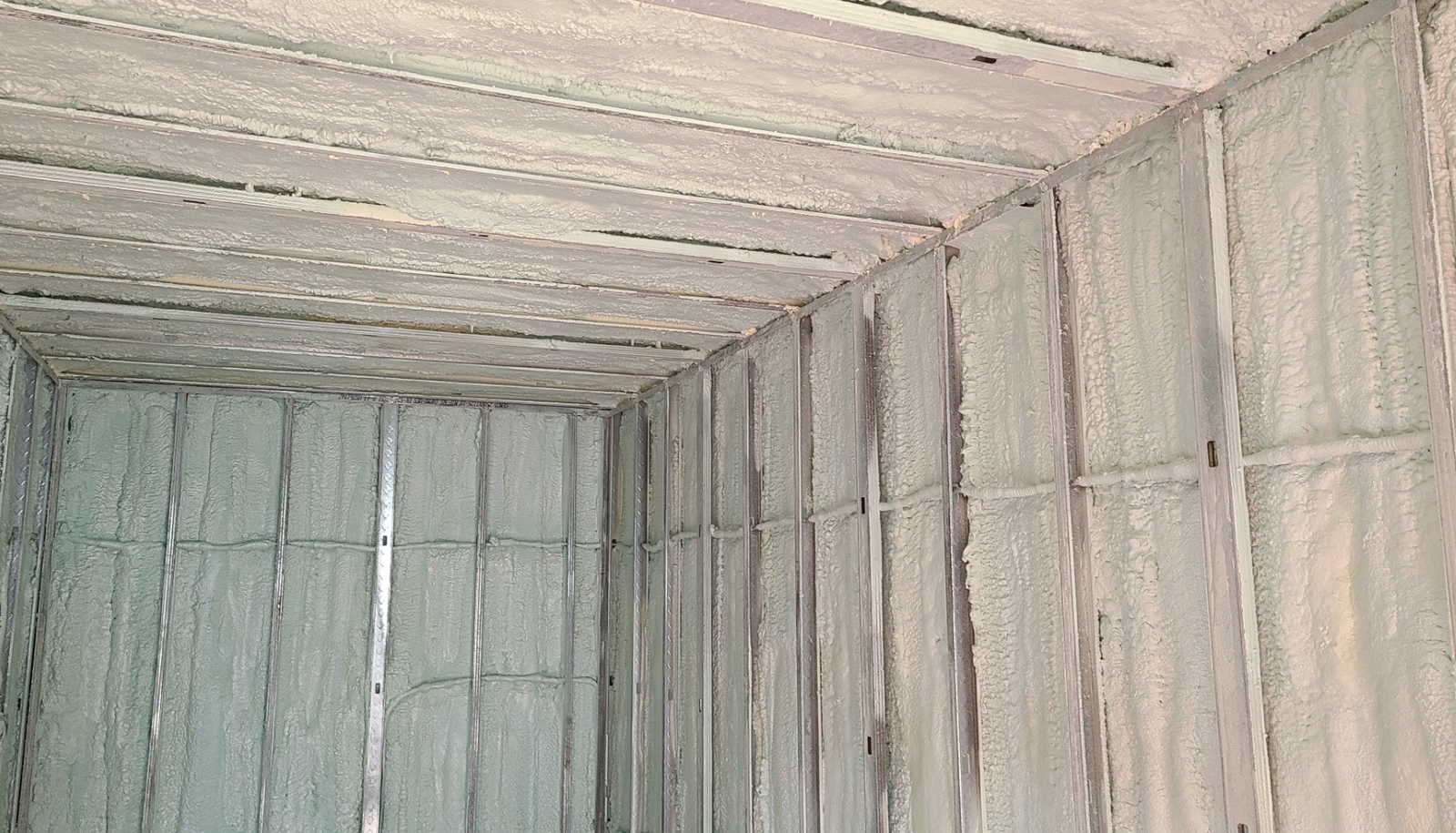
Where spray foam insulation is used
- Metal roofs of warehouses, factories and PEB sheds: cuts summer heat gain and stops condensation dripping from the sheet.
- Cold rooms, ripening chambers and cold storage: 80–100 mm closed-cell foam on walls and ceilings, often alongside PUF/PIR sandwich panels — see our mini cold storage price guide.
- Shipping containers and site cabins: converting containers into offices, stores and prefab buildings.
- RCC terraces and roof slabs: seamless insulation under a protective coating for top-floor comfort.
- Poultry and dairy sheds: lower shed temperature in peak summer.
- Water tanks and pipework: spray foam tank insulation for irregular shapes.
Closed-cell spray foam vs other roof insulation
Closed-cell spray foam insulation gives the lowest thermal conductivity of the common roof and wall options and is the only one that also air-seals every joint. For process heat above 107 °C choose a high-temperature material instead, such as aerogel insulation or microporous insulation. Use our insulation thickness calculator to compare thicknesses, and design to the Bureau of Energy Efficiency Energy Conservation Building Code (ECBC) roof U-value for commercial buildings.
| Option | Joints / air sealing | Retrofit on existing roof | Best for |
|---|---|---|---|
| Closed-cell spray foam | Seamless, air and vapour seal | Yes, sprayed in place | Existing metal roofs, cold rooms, irregular surfaces |
| PUF/PIR sandwich panels | Panel joints to be sealed | Needs re-roofing | New sheds, cold stores, prefab buildings |
| Glass wool / mineral wool | Joints; needs a vapour barrier | Needs support system | False ceilings, acoustics, new construction |
How spray foam insulation is applied
- Site survey: area, substrate, access, target thickness and dew-point check; a firm rate follows.
- Surface preparation: the substrate must be clean, dry, free of oil and rust, and within 21–43 °C.
- Spraying: a heated high-pressure rig (Graco E-20 class, ≥82 bar) applies 20–55 mm per pass; thicker specifications are built up in multiple passes.
- Quality records: thickness mapping and density coupons are recorded and handed over.
- Protection: exposed foam gets a UV-resistant topcoat; interior foam can be covered where a thermal barrier is required.
Why buy spray foam insulation from Wedge Industries Limited
- Own crew, own chemicals: application by Wedge’s certified crew from Faridabad, using the same systems we supply to other applicators.
- Transparent pricing: published ₹/m² and ₹/sq ft bands, a firm quote after survey, and a thickness map with every job.
- Coverage: Delhi NCR direct, with Lucknow and insulation contractor partners across India.
- Complete envelope: spray foam, sandwich panels, XPS, cold storage and fire protection from one supplier; Wedge Industries Limited exports to 45+ countries including UAE, Saudi Arabia, Qatar and Kuwait.
Get a spray foam insulation quote in 24 hours
Send the area in m² or sq ft, surface type (metal roof, RCC slab, cold room, container), target thickness and location. You will receive a rate in ₹ and $ within one working day, confirmed after site survey.
Spray foam insulation FAQs
How much does spray foam insulation cost in India?
Closed-cell spray foam insulation costs about ₹970–1,025 per m² (₹90–95 per sq ft) applied at 50 mm, ₹1,420–1,500 per m² at 80 mm and ₹1,720–1,820 per m² at 100 mm, excluding GST. Final rates are confirmed after a site survey; the minimum billable area is 200 m².
What thickness of spray foam do I need?
50 mm is the usual specification for warehouse, factory and shed roofs; 80 mm for cold rooms and chillers; 100 mm for deep-freeze rooms and blast freezers. Use the insulation thickness calculator or send your temperatures for a recommendation.
Is closed-cell or open-cell spray foam better?
Closed-cell spray foam is better for Indian roofs and cold storage: it has lower thermal conductivity (0.020–0.023 W/m·K), resists moisture and acts as a vapour barrier. Open-cell foam absorbs water and is not suitable for humid climates or cold chain work.
Does spray foam stop condensation on metal roofs?
Yes. Sprayed onto the underside of the sheet, closed-cell foam keeps the inner surface above dew point and seals the joints where humid air would otherwise condense, which stops the dripping that damages stock and machinery.
Is spray foam insulation fire resistant?
Spray polyurethane foam is a combustible organic material. The systems Wedge uses include a fire retardant and meet UL 94 HF-1 and FMVSS 302; where building codes require it, the foam is covered with a thermal barrier or fire-protective coating.
Do you supply spray foam chemicals to applicators?
Yes. Wedge supplies matched polyol and isocyanate drum sets in an imported spec grade and a local fast-supply grade. Each 400–440 kg set covers about 188–207 m² at 50 mm. Ask for a live ₹/kg and $/kg quote with your annual volume.
Stop roof heat and condensation in one pass
Tell us the area, surface and location — we will send a spray foam insulation rate in ₹ and $ and book a site survey.