
The best thermal insulation for BESS (Battery Energy Storage Systems) is a silica aerogel thermal-runaway pad with thermal conductivity of 0.018 W/m·K at 25 °C, UL94 V-0 flame rating and EN 13501-1 Class A1 fire reaction — fitted cell-to-cell and module-to-module inside the pack. With India tendering 92 GWh of BESS capacity by end-2025 and UL 9540A / NFPA 855 (2026) now demanding large-scale fire testing, thermal runaway barriers are no longer optional — they are a purchase-order line item on every BESS build.
Wedge Industries Limited manufactures the complete BESS insulation stack — from cell-level aerogel pads to container-level fire barriers — with dispatch across India and export to 45+ countries. Request a quote from the recommendation table below.
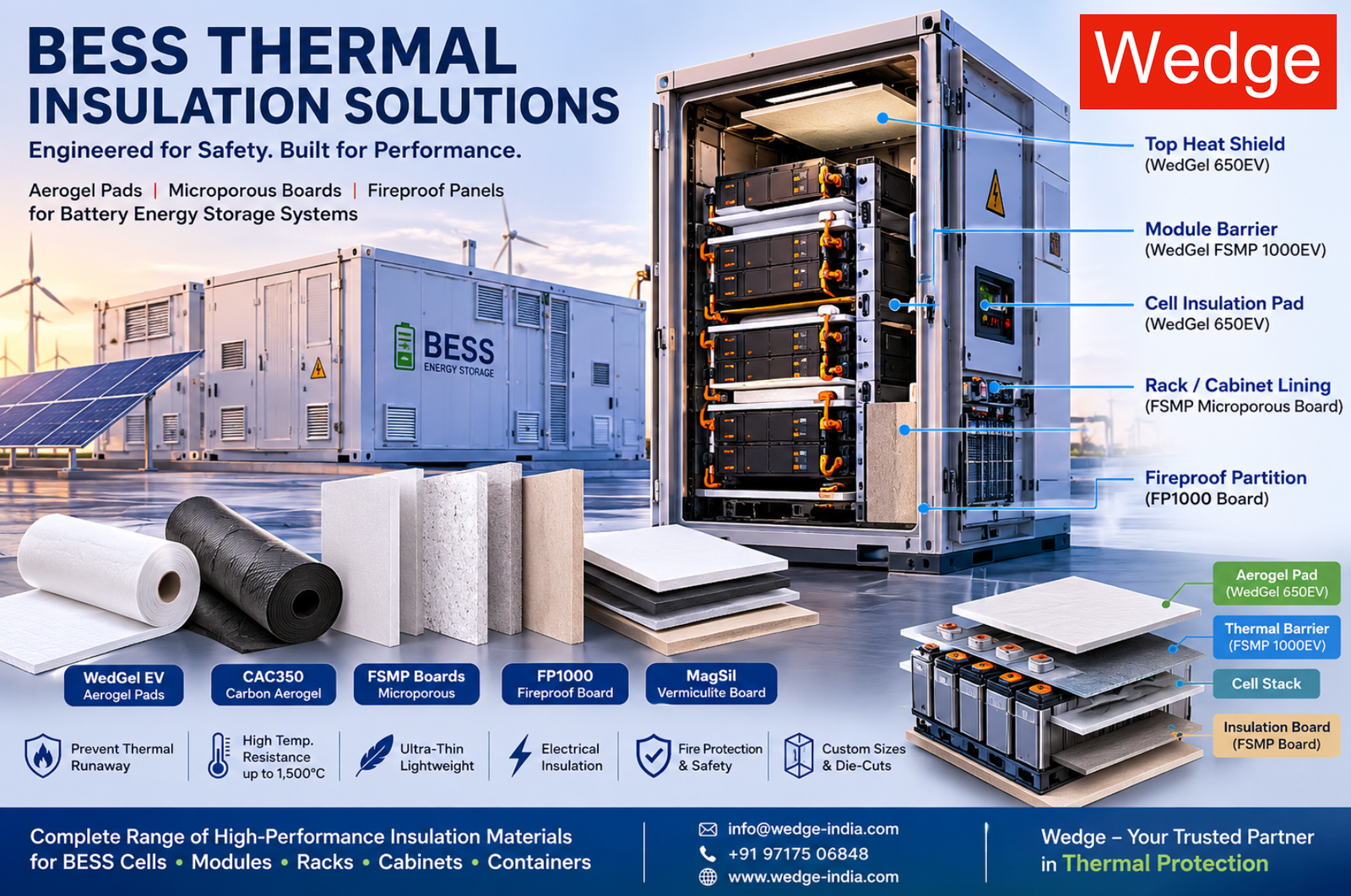
Why BESS Needs Thermal Runaway Insulation
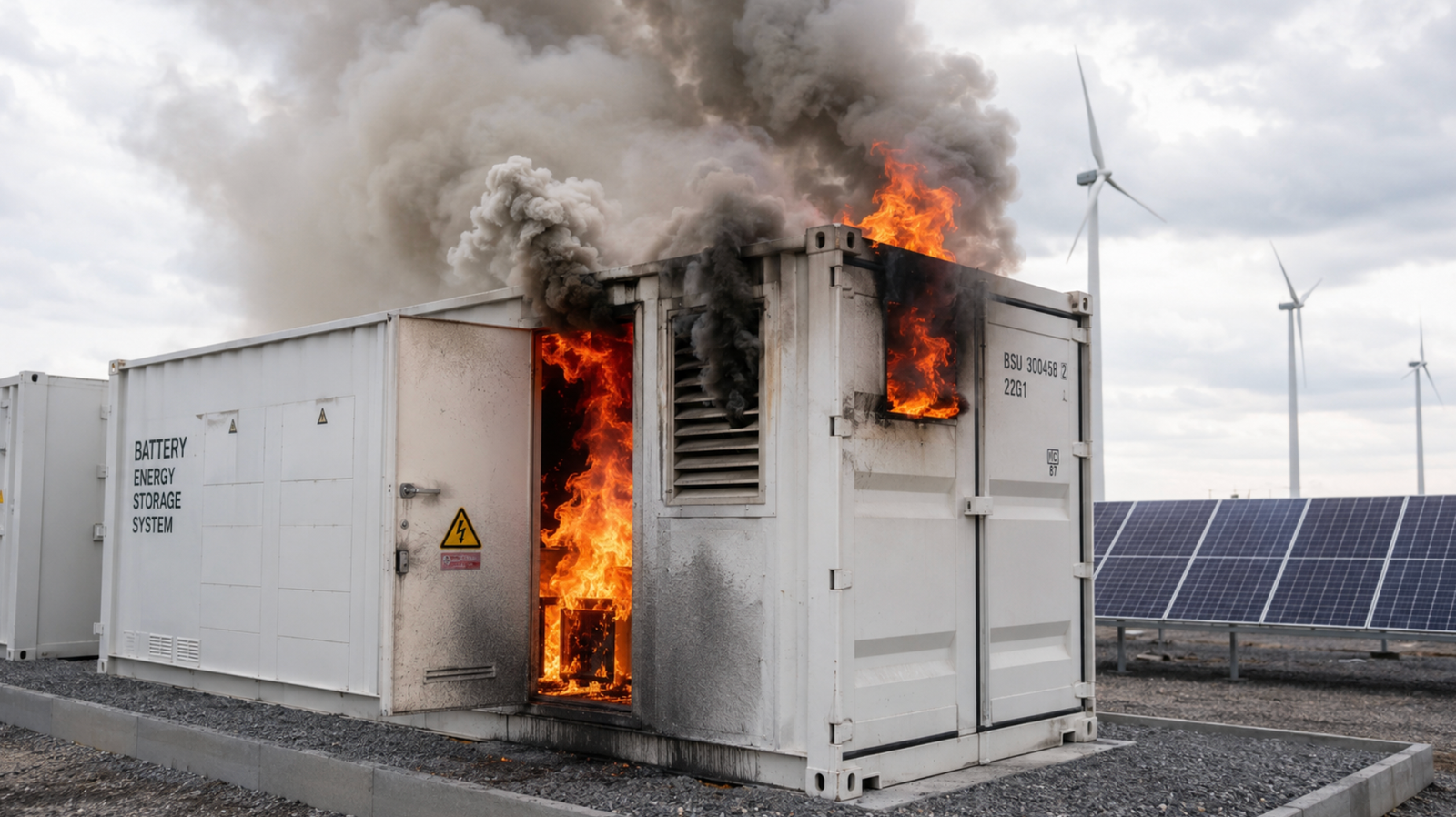
When a lithium-ion cell fails, it can exceed 1,000 °C within seconds and cascade to neighbouring cells. UL 9540A tests exactly this — cell, module and installation-level fire propagation — and NFPA 855 (2026 edition) requires large-scale fire testing that evaluates whether fire spreads between BESS units. A thin, non-combustible barrier between cells and modules is the most cost-effective way to pass.
The barrier must do four jobs at once: block heat (low W/m·K), survive flame (1,200 °C+ short-term), insulate electrically (≥10 kV/mm) and stay thin (0.24–10 mm) so pack energy density is not compromised.
The 4 Best BESS Thermal Barrier Materials — WedGel EV Series
The WedGel EV range covers four grades. All pass UL94 V-0 and ISO 1182 / EN 13501-1 Class A1.
| Property | WedGel 650EV | WedGel AlSi 250EV | WedGel FSMP 1000EV | WedGel OXF |
|---|---|---|---|---|
| Thermal conductivity @25 °C | 0.018 W/m·K | 0.04 W/m·K | 0.021 W/m·K | 0.023 W/m·K |
| Service temperature | −50 / +700 °C | −10 / +1,300 °C | +6 / +1,000 °C | −50 / +700 °C |
| Short-term withstand | 1,400 °C | ≥1,500 °C | ≥1,400 °C | 1,400 °C |
| Thickness | 0.24–10 mm | 0.8–10 mm | 2–10 mm | 0.3–10 mm |
| Breakdown voltage | ≥10 kV/mm | 2–8 kV/mm | ≥10 kV/mm | ≥10 kV/mm |
| Flexibility | Low–Medium | High | Low | Very High |
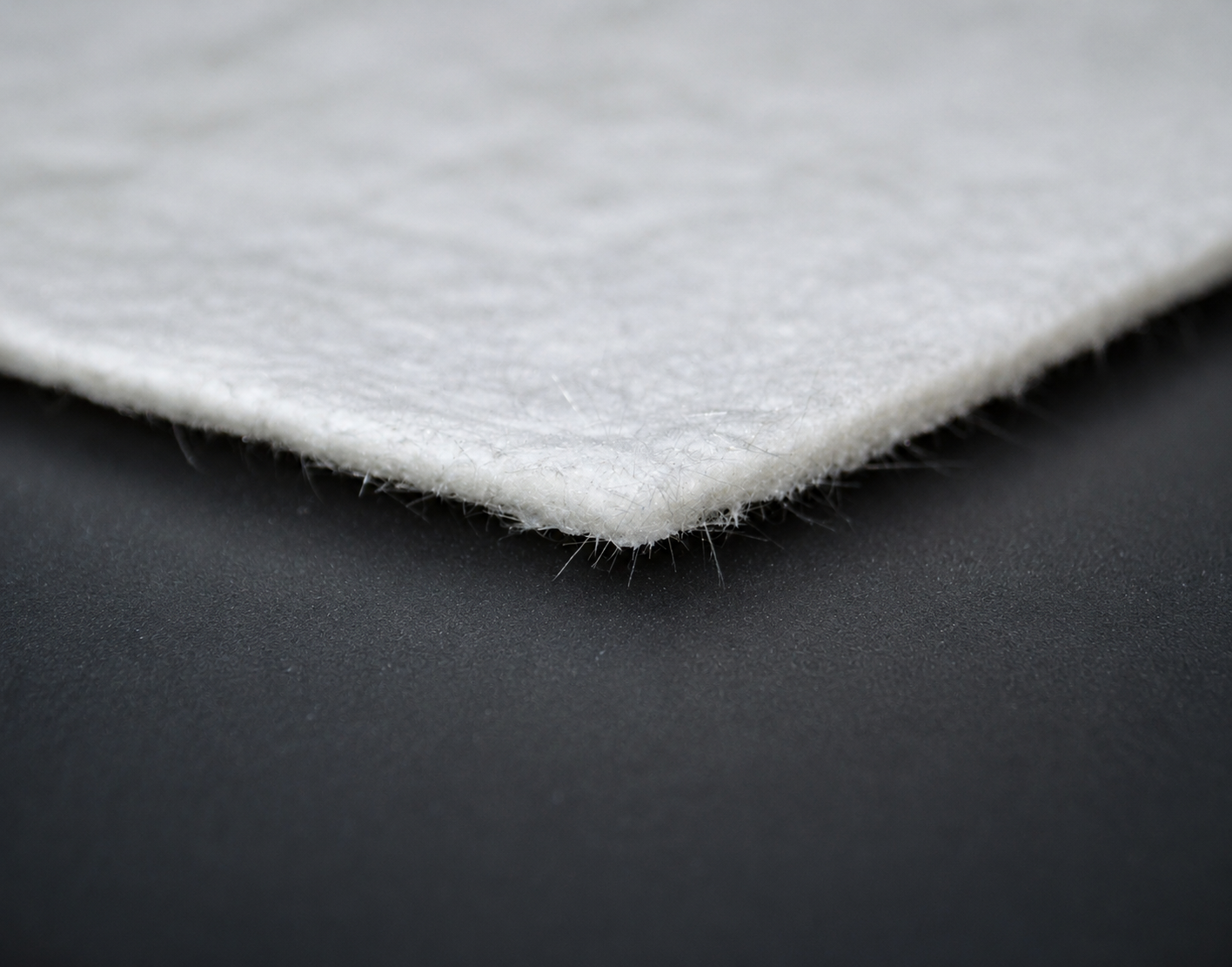
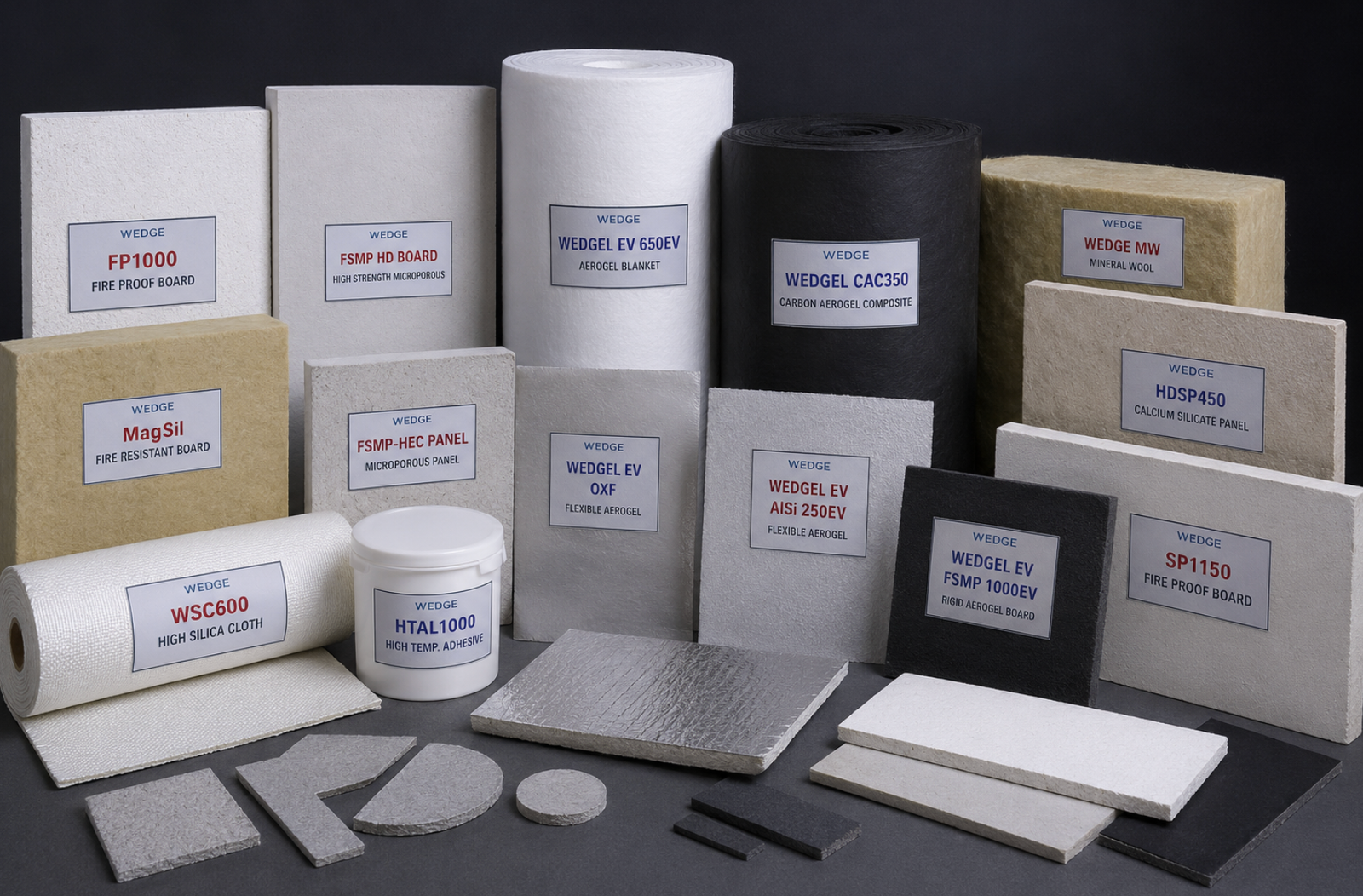
Which one should you buy? Specify WedGel 650EV for cell-to-cell wraps where the lowest lambda and highest dielectric strength matter. Specify WedGel AlSi 250EV where the barrier must flex around busbars and survive 1,300 °C continuous. Choose FSMP 1000EV for rigid module-to-module plates, and WedGel OXF (oxidised-PAN aerogel) where maximum conformability is needed. For welding-adjacent zones and pack fire blankets, WedGel CAC350 carbon-fibre aerogel composite is the drop-in option.
Container and Enclosure Insulation for BESS
Cell pads alone do not pass an installation-level UL 9540A test. Wedge Industries Limited supplies the balance of the system from stock:
- Microporous insulation boards and quilted panels (900–1,260 °C, 8 product types) — thin hot-face barriers behind battery racks and cable trays. See the rigid microporous board 6AL.
- Phlogopite mica tape — busbar and cable wrap with high dielectric strength at elevated temperature.
- Calcium silicate boards (1,100 °C grade) — fire-rated flooring and enclosure lining.
- Rock/mineral wool — container envelope thermal and acoustic insulation, keeping HVAC loads down in 50 °C+ Gulf and Indian summers.
- Fire & blast protection partitions and intumescent strips — NFPA 855 separation between BESS containers and transformers. See our transformer fire and blast partition.
BESS Insulation Price in India
WedGel EV pads are priced per die-cut piece against your cell footprint and thickness (0.24–10 mm), so a drawing or cell model number gets you an exact ₹ and $ price — typically within one business day. Container-level materials (microporous board, calcium silicate, rock wool, fire partitions) are quoted per m² or per board with volume slabs for GWh-scale projects. Indicative pricing, MOQ and delivery schedule are confirmed on enquiry — request a BESS quote here.
Export Supply — Gulf, USA, UK
Wedge Industries Limited manufactures in India, the UK, Spain and China and exports BESS insulation to 45+ countries. UL94 V-0 and EN 13501-1 Class A1 documentation is supplied with every export consignment — relevant for UAE Civil Defence approvals, Saudi HCIS-governed sites, and UL 9540A-driven projects in the USA. Gulf BESS and solar-plus-storage EPCs can request CIF quotes to Jebel Ali, Dammam and Doha.
Planning a battery storage project in India? See our BESS in India 2027 guide for market size, VGF subsidy, state policies and the CEA safety rules that apply from 01-04-2027.
FAQs
What is the best insulation material for BESS?
Silica aerogel thermal-runaway pads such as WedGel 650EV are the best cell-level barrier — 0.018 W/m·K at 25 °C, 1,400 °C short-term withstand, UL94 V-0, in thicknesses from 0.24 mm.
What insulation is used between battery cells?
Thin die-cut aerogel pads (0.24–3 mm) are placed between prismatic cells; flexible grades like WedGel OXF or AlSi 250EV wrap cylindrical cells and busbars.
Does BESS insulation need UL 9540A?
UL 9540A tests the system, not the material — but barriers rated UL94 V-0 and EN 13501-1 Class A1, like the WedGel EV series, are what allow packs and installations to pass propagation testing.
What temperature does a battery reach in thermal runaway?
A failing lithium-ion cell can exceed 1,000 °C. BESS barriers should therefore offer short-term withstand of at least 1,200 °C; WedGel EV grades withstand 1,400–1,500 °C.
Can Wedge Industries Limited supply BESS insulation outside India?
Yes — export supply to 45+ countries with manufacturing in India, the UK, Spain and China, including CIF delivery to Gulf ports and full fire-test documentation.
Get a BESS Insulation Quote in 24 Hours
Send your cell dimensions, rack layout or container drawings and we will return a priced bill of materials — cell pads, module barriers, enclosure boards and fire partitions — in ₹ and $. Request a quote → or explore the WedGel aerogel portfolio selector to shortlist grades yourself.

Written by
Aishwar Bhatt
Techno-Commercial Consultant at Wedge India
Aishwar Bhatt is a Techno-Commercial Consultant at Wedge India (Wedge Industries Limited). He advises engineers, contractors and procurement teams on insulation, passive fire protection and building materials — from product selection and specifications to pricing and supply.
Connect on LinkedIn