
India’s battery energy storage (BESS) market is moving from pilots to scale. The country added about 4.6 GWh of battery storage in Q1 2026 alone, the project pipeline stands at 69–92 GWh, and the National Electricity Plan calls for about 236 GWh of battery storage by 2031–32. Projects get Viability Gap Funding of ₹18 lakh per MWh (≈ $20,500), and from 01-04-2027 new CEA safety rules make fire detection, suppression and explosion protection compulsory in larger BESS containers.
This guide explains what that means for developers, integrators, pack assemblers and EPC contractors, and where thermal insulation and fire barriers fit into a BESS design.
- Installed BESS: about 5.9 GWh (March 2026); 4.6 GWh added in Q1 2026.
- Pipeline: 69–92 GWh; 102 GWh tendered across 69 tenders in the last year.
- Storage cost per kWh delivered fell from about ₹10.18 (2022–23) to about ₹2.1 in recent tenders.
- Central support: ₹5,400 crore VGF for 30 GWh, 100% ISTS waiver for co-located BESS commissioned by 30-06-2028, 20% domestic-content rule.
- CEA safety amendment 2026 applies from 01-04-2027 — fire and thermal design becomes a compliance item, not an option.
What Is a Battery Energy Storage System (BESS)?
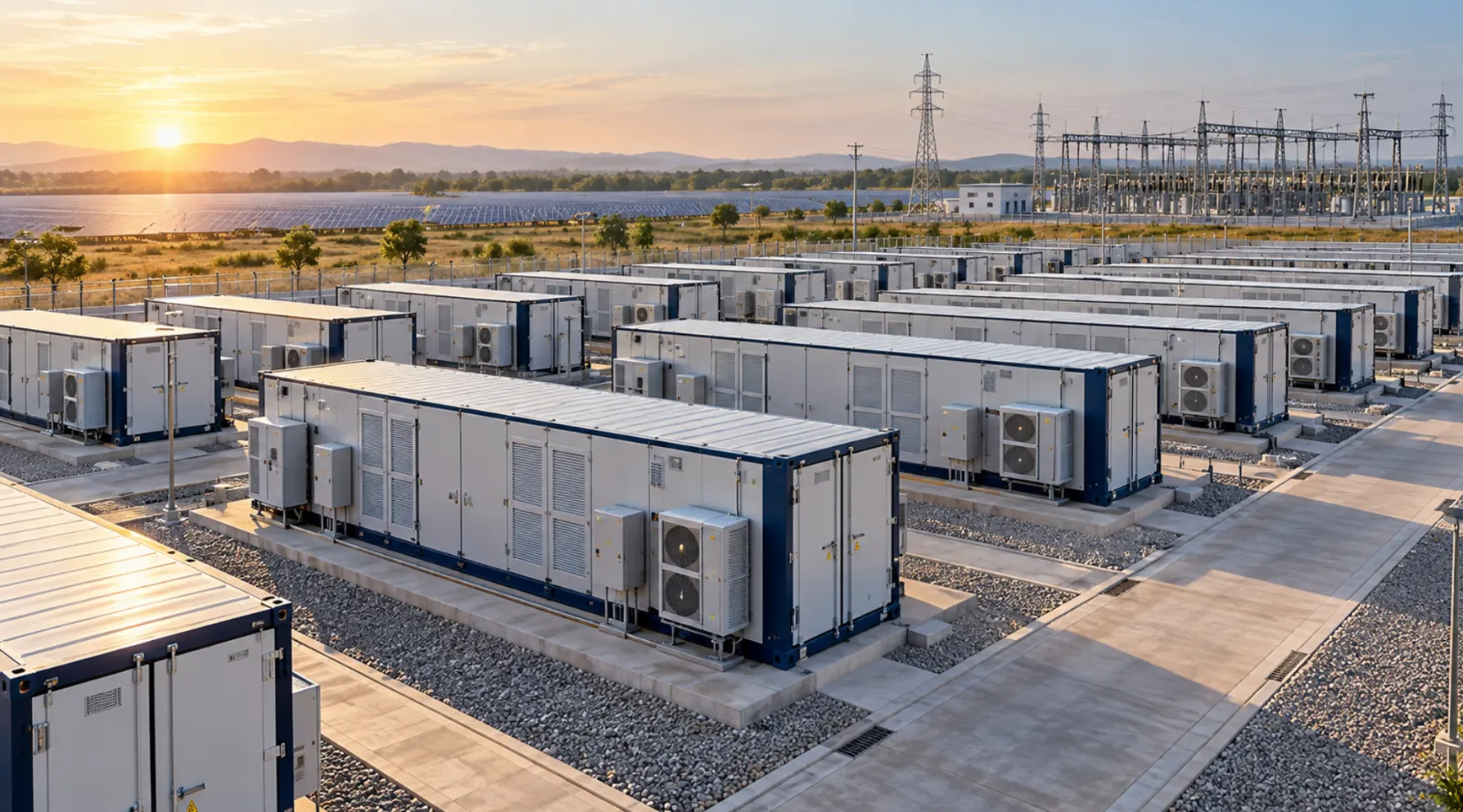
A BESS stores electricity in rechargeable batteries — today mostly lithium iron phosphate (LFP) cells — and releases it when the grid or the site needs it. A complete installation includes:
- Battery cells, modules and racks
- Battery management system (BMS) and energy management system (EMS)
- Power conversion system (inverters and transformers)
- HVAC or liquid cooling
- Electrical protection, monitoring and fire detection/suppression
- Containers, enclosures or dedicated battery rooms
GW vs GWh: GW is how much power the system can deliver; GWh is how much energy it stores. A 100 MW / 200 MWh system runs for about two hours at full output. Tenders in India are now mostly 2-hour and 4-hour systems.
India BESS Market Size: 2026 Status and Outlook to 2035
Different trackers count capacity differently, so treat single numbers with care. The ranges below are from the Ministry of Power, CEA, IESA, JMK Research and trade press published between December 2025 and August 2026.
| Metric | Figure | Source |
|---|---|---|
| Installed BESS (March 2026) | About 5.9 GWh (some trackers count under 1 GWh) | ESS News, 17-06-2026 |
| Additions, Q1 2026 | 4.6 GWh, against 0.44 GWh in the previous quarter | ESS News, 17-06-2026 |
| Pipeline | 69 GWh (tracker) to 92 GWh (IESA) | ESS News; pv magazine India |
| Tendered in the last year | 69 tenders, 102 GWh (+35% vs 2024) | IESA |
| Standalone BESS, May 2026 | 35,000+ MWh awarded, 29,000+ MWh under bidding, 4,700+ MWh operational | Renewable Watch, 30-06-2026 |
| Battery storage need by 2031–32 | 47.24 GW / 236.22 GWh (part of 411.4 GWh total storage incl. pumped hydro) | National Electricity Plan (CEA) |
| Installed stationary storage by 2033 | 346 GWh base case; 544 GWh with policy momentum | IESA, March 2026 |
| Storage by 2035–36 | 174 GW, of which about 80 GW battery | CEA via Renewable Watch |
| Commercial & industrial (C&I) storage by 2032 | About 31 GWh | IESA–CES |
Where the demand is
- Segments: standalone grid batteries are about 73% of installed capacity and 41 GWh of the 69 GWh pipeline; round-the-clock (FDRE) and solar-plus-storage projects make up most of the rest.
- States: Rajasthan (~13% of the tracked pipeline), Gujarat (~9%), Andhra Pradesh (~5%) and Maharashtra (~4%), followed by Bihar, Uttar Pradesh, Kerala and Tamil Nadu.
- Buyers: utility developers and PSUs, BESS integrators and container assemblers (India has about 60 GWh of pack-assembly capacity), cell makers, and C&I users — factories replacing diesel backup, data centres, hospitals and railways.
Cost and tariff trend
| Item | ₹ | $ (at ₹88) |
|---|---|---|
| Storage cost per kWh delivered, 2022–23 tenders | ≈ ₹10.18 | ≈ $0.116 |
| Storage cost per kWh delivered, recent tenders (no VGF) | ≈ ₹2.1 | ≈ $0.024 |
| Standalone tariff, 2-hour (Feb–May 2026, L1) | ₹1.48 lakh / MW / month | ≈ $1,680 |
| Standalone tariff, 4-hour (Feb–May 2026, L1) | ₹2.85 lakh / MW / month | ≈ $3,240 |
| GUVNL 450 MW / 900 MWh (Aug 2026) | ₹2.32 lakh / MW / month | ≈ $2,640 |
A roughly 79% fall in delivered storage cost is what turned BESS from a pilot technology into a bankable grid asset. LFP cells traded near $55/kWh in China in June 2026; landed cost in India is 10–25% higher.
Government Schemes and Subsidies for BESS in India
Support is strong for projects and much thinner for manufacturing. Here is the current picture.
Central government
| Instrument | Terms | Applies to |
|---|---|---|
| VGF – first tranche | ₹3,760 crore (≈ $415 million reported) for 4,000 MWh, paid over three years; later reports describe a wider 13,220 MWh scope | Projects |
| VGF – second tranche (June 2025) | ₹5,400 crore (≈ $631 million reported) from the Power System Development Fund for 30 GWh — 25 GWh across 15 states, 5 GWh for NTPC; ₹18 lakh per MWh; 2-hour or 4-hour standalone systems | Standalone projects procured by states and agencies |
| 20% domestic content | At least 20% of BESS procurement cost must be local content (including EMS software) for VGF projects | VGF projects |
| ISTS charge waiver | 100% waiver for co-located BESS commissioned by 30-06-2028; standalone BESS follow separate orders | Projects |
| Co-location advisory (Feb 2025) | 2-hour storage equal to 10% of solar capacity in future solar tenders | Solar tenders (advisory) |
| PLI for Advanced Chemistry Cells | ₹18,100 crore for 50 GWh of cells (10 GWh for stationary storage); about 1.4 GWh commissioned by October 2025 | Cell manufacturers |
| Customs duty (Budget 2026–27) | Duty exemption on capital goods for Li-ion cell manufacturing extended to cells for BESS | Manufacturers |
| GST | Li-ion batteries stay at 18%; lead-acid, sodium and flow batteries cut from 28% to 18% from 22-09-2025 | Projects and manufacturers |
A July 2026 Ministry of Power statement links the national battery storage requirement to investment of about ₹3.49 lakh crore (≈ $40 billion). That is the scale of the industry — not the size of the insulation market, which depends on each system’s design and bill of materials.
State policies
| State | What it offers | Status |
|---|---|---|
| Maharashtra | New RE projects above 100 kW must add storage of at least 50% of RE capacity from 01-04-2026; storage exempt from transmission, wheeling and cross-subsidy charges for in-state use; DISCOMs to procure storage equal to 10% of demand by FY2035–36 | Strongest mandate in India |
| Rajasthan | RERC BESS Regulations 2026 — grid BESS from 1 MW/2 h, behind-the-meter storage, aggregators; draft procedure (Aug 2026) for mandatory BESS in RE projects | Notified; waivers to be confirmed |
| Gujarat | GERC Grid-Interactive BESS Regulations 2026; GUVNL standalone auctions; Tata Agratas 40 GWh cell plant at Sanand | Active procurement |
| Tamil Nadu | Draft BESS Regulations 2026 with fire detection, prevention and end-of-life rules | Draft |
| Karnataka | 2,000 MWh of state-owned BESS (≈ ₹3,400 crore) at Huliyur, Pavagada and Kushtagi | Budget 2026–27 |
| Andhra Pradesh | Integrated Clean Energy Policy — 160 GW RE by 2029; pilot support for emerging storage | BESS eligibility unclear |
| Uttar Pradesh | UPERC approved 1,130 MWh joint procurement (June 2026); EV/battery manufacturing policy with up to 30% capital subsidy | Confirm current terms |
CEA BESS Safety Rules 2026: Why 01-04-2027 Matters
The Central Electricity Authority’s 2026 safety amendment applies to grid BESS from 01-04-2027. For systems above 650 V it requires:
- Two-fault-tolerant design
- Smoke, gas, heat and flame detection
- Automatic fire suppression in every container
- Explosion protection, forced ventilation and HVAC
- Minimum spacing from buildings
- An independent fire audit within three months of commissioning
A list of applicable standards is due within three months of commencement. The rule text summarised in the trade press does not name insulation or fire barriers directly, but containing a thermal event — keeping it inside one module, rack or container — is how most integrators show compliance with fire-spread and spacing requirements. That makes thermal barriers, fire-rated partitions and sealed penetrations a design item for every project commissioning in 2027 and later.
Thermal Runaway: Why BESS Insulation and Fire Protection Matter
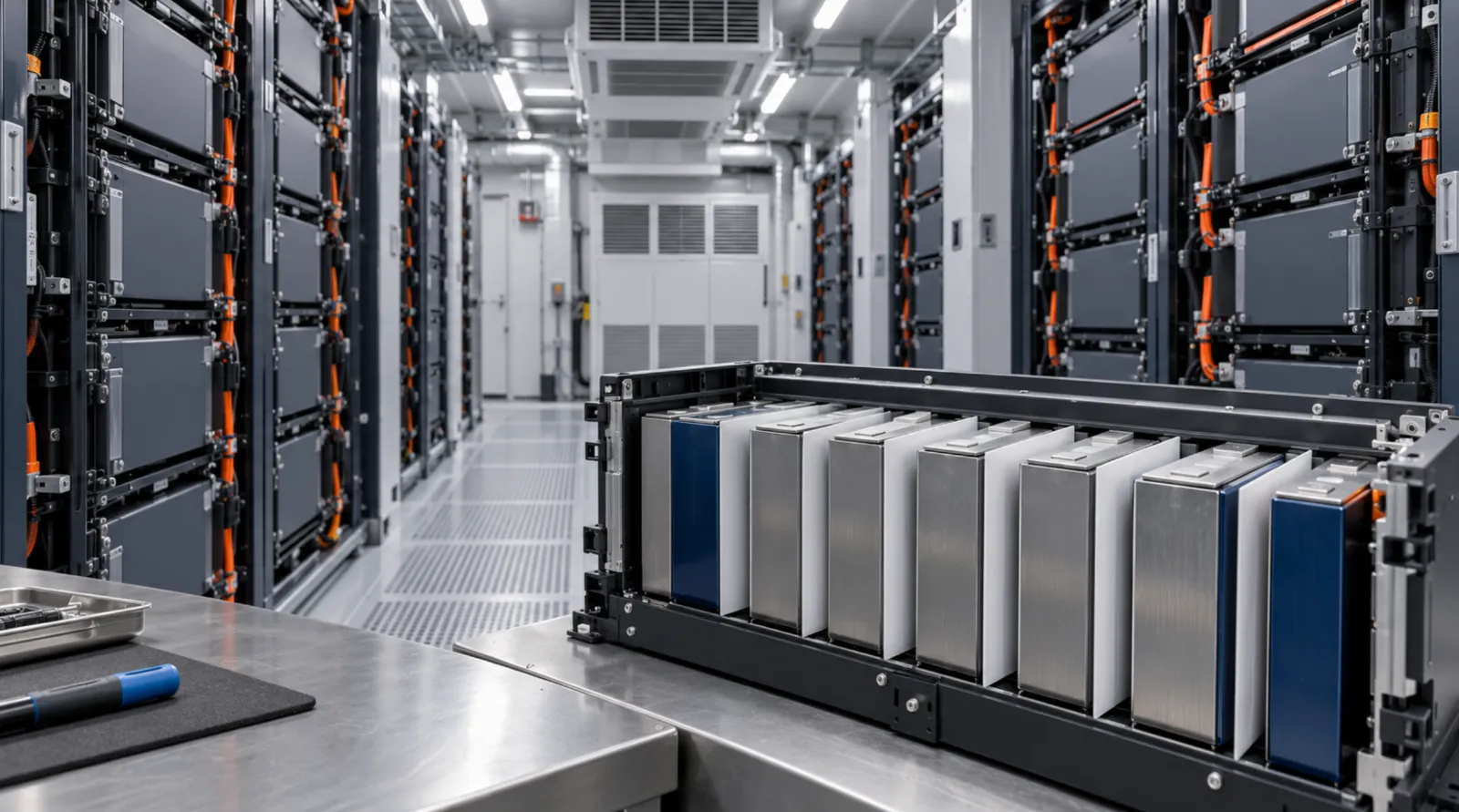
When one cell fails it can heat to several hundred degrees within seconds and vent hot gas. Without a barrier, that heat passes to the neighbouring cell, then the next — a chain reaction called thermal runaway propagation. Passive barriers slow or stop the heat transfer so the BMS, ventilation and suppression systems have time to act.
Insulation does not replace cooling. In normal operation the cells must shed heat. A barrier in the wrong place can block a designed cooling path, so barrier position, thickness and compression must be set together with the thermal design — not added later.
Where Insulation and Fire Protection Go in a BESS
| Location | Function | Materials to evaluate |
|---|---|---|
| Between cells | Slow cell-to-cell heat transfer while handling cell swelling | Aerogel pads 1–3 mm, mica sheets |
| Between modules / under module lids | Stop vented gas and flame reaching the next module; electrical isolation | Mica barrier plates, ceramic or aerogel felt |
| Rack-to-rack and container walls | Fire compartmentation; protect adjacent racks and the PCS | Calcium silicate and fire-rated boards, ceramic fibre |
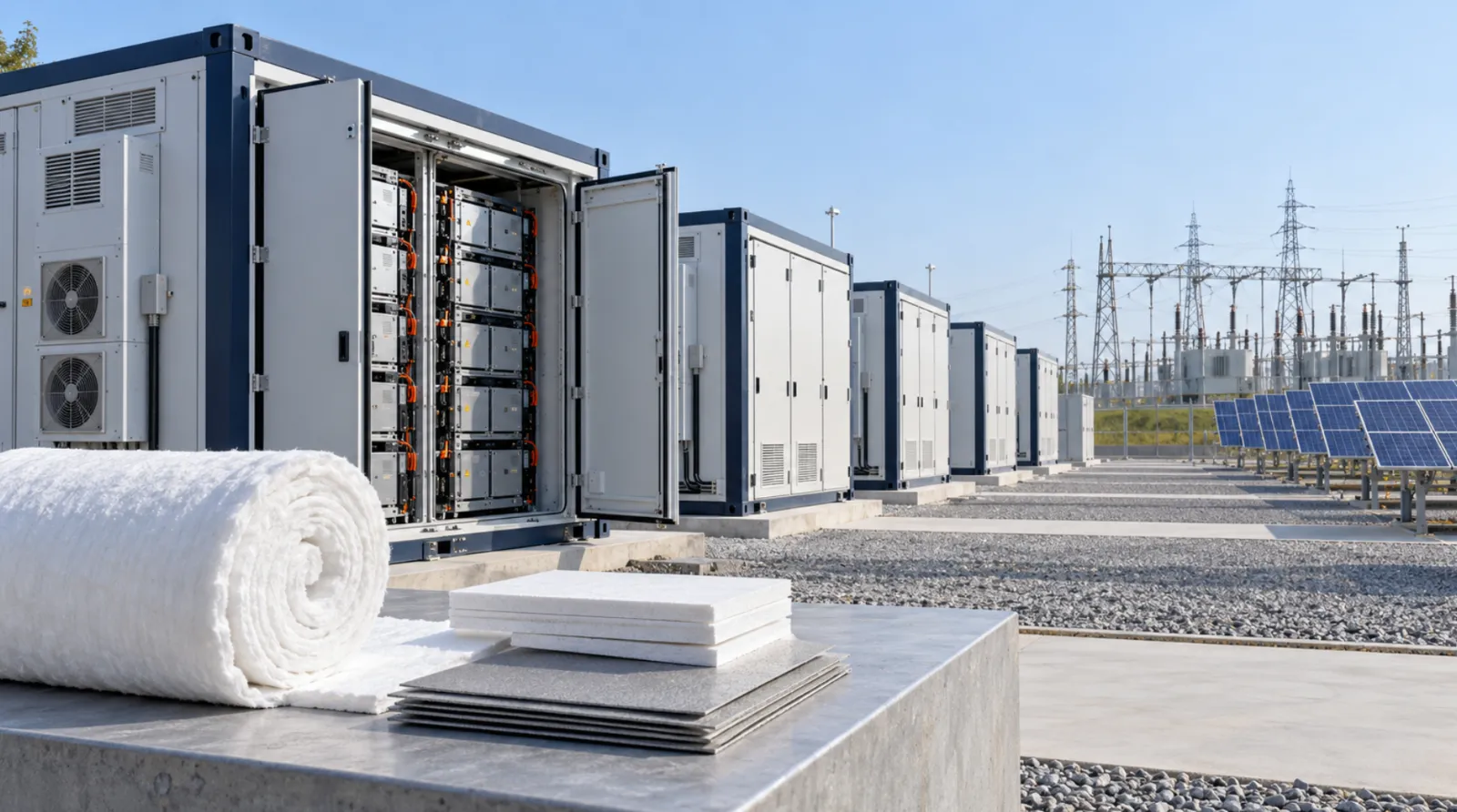
| Container envelope | Reduce solar heat gain and HVAC load; condensation control | Aerogel blanket, insulated panels |
| Cable and duct penetrations, joints | Keep the fire barrier intact where services pass through | Intumescent seals and fire stopping |
| Battery rooms in buildings (C&I, data centres) | Fire-rated room construction and doors | Fire boards, intumescent strips, fire door components |
BESS Insulation Materials Compared
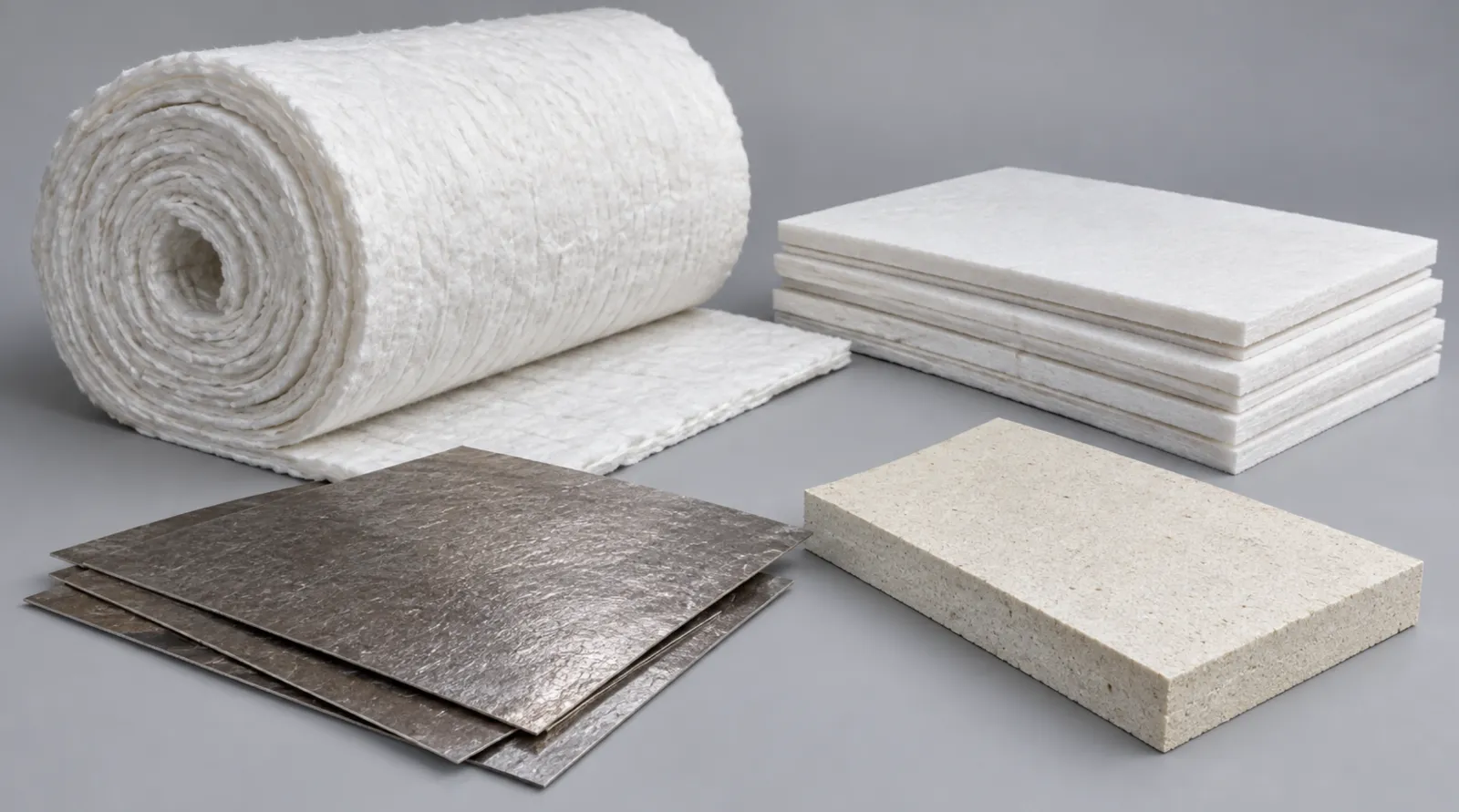
These are candidate material families, not interchangeable or pre-approved solutions. Two products with the same name can differ in binder, reinforcement and behaviour at high temperature, so each must be checked in the actual assembly.
| Material | Best use in BESS | Strength | Check before you specify |
|---|---|---|---|
| Aerogel composite pads and blankets | Thin cell-to-cell and module barriers; container walls | Lowest thermal conductivity per mm, so the thinnest barrier | Behaviour at high temperature, compression set, dust, edge sealing |
| Mica sheets and laminates | Module lids, busbar isolation, vent-gas shields | High dielectric strength and flame resistance | Binder behaviour, mechanical integrity after exposure |
| Ceramic and high-temperature fibre | Rack and enclosure barriers, gaskets | Rated well above 1,000 °C | Encapsulation, erosion by vent gas, handling |
| Calcium silicate and fire boards | Partitions, battery rooms, enclosure linings | Rigid, non-combustible, machinable | Complete assembly rating, joints and fixings, moisture |
| Intumescent seals and fire stopping | Penetrations, joints, door edges | Expands to close gaps in a fire | Tested substrate and opening size, installation details |
For a deeper comparison of barrier materials see best thermal insulation for BESS, and for pad thickness and die-cut formats see aerogel for BESS. Indicative aerogel rates are in our aerogel price guide, and the basics are in what is aerogel insulation.
How to Specify a BESS Thermal Barrier
Start from the function and the installation position, then share these six inputs with your supplier:
- Battery configuration — chemistry (LFP, NMC, sodium-ion), cell format, module and rack layout.
- Thermal exposure — normal operating range and the abnormal event being designed for.
- Mechanical — available space, thickness tolerance, compression from cell swelling, vibration.
- Electrical — dielectric strength and clearance requirements.
- Environment — humidity, condensation, dust and design life (often 15–20 years).
- Validation — component tests plus representative module, rack or system testing.
UL 9540A is a test method for thermal-runaway fire propagation at cell, module, unit and installation level. It is not a certificate an insulation sheet can carry on its own — the result belongs to the tested assembly. Check the standards list CEA publishes under the 2026 amendment, plus any project requirements such as IEC 62933-5-2, UL 9540 or NFPA 855.
Who Should Plan Now
- BESS integrators and container builders — barrier design must be frozen before 2027 commissioning dates.
- Pack and module assemblers — local barrier sourcing can support the 20% domestic-content requirement on VGF projects (confirm how it is counted with the procuring agency).
- EPC contractors and developers — battery rooms, cable penetrations and spacing all feed into the independent fire audit.
- C&I users and data centres — indoor battery rooms need fire-rated construction alongside the storage system; see our EV and battery insulation range.
Discuss Your BESS Insulation and Fire Protection Requirement
Wedge Industries Limited supplies aerogel pads and blankets, mica barriers, ceramic fibre, calcium silicate boards and intumescent fire-stopping to battery integrators, pack assemblers and EPC contractors. Send us your drawing, dimensions, quantities, temperature conditions and required standards, and we will propose suitable grades and samples.
Frequently Asked Questions
How big is the BESS market in India?
India had about 5.9 GWh of battery storage installed in March 2026 and added 4.6 GWh in Q1 2026. The pipeline is 69–92 GWh, and the National Electricity Plan projects about 236 GWh of battery storage by 2031–32. IESA forecasts 346–544 GWh by 2033.
Is there a government subsidy for BESS in India?
Yes, for projects. The Viability Gap Funding scheme provides ₹5,400 crore for 30 GWh at ₹18 lakh per MWh, and co-located BESS commissioned by 30-06-2028 get a 100% ISTS charge waiver. There is no central subsidy dedicated to BESS pack assembly or insulation manufacturing.
What are the new CEA safety rules for BESS?
From 01-04-2027, grid BESS above 650 V must be two-fault tolerant and have smoke, gas, heat and flame detection, automatic fire suppression in every container, explosion protection, ventilation, minimum spacing from buildings and an independent fire audit within three months.
Which insulation is used in battery energy storage systems?
Common choices are aerogel pads between cells, mica sheets for module lids and electrical isolation, ceramic fibre and calcium silicate boards for rack and enclosure barriers, and intumescent seals for penetrations. The right choice depends on the position, space, temperature and validation needed.
Can insulation prevent thermal runaway?
No insulation can guarantee prevention. A well-designed barrier delays heat transfer and can stop propagation from one cell or module to the next, but safety depends on the whole system — BMS, cooling, detection, ventilation and suppression.
Is aerogel suitable for BESS?
Selected aerogel composites are widely used as thin thermal barriers in battery packs because they give the lowest heat transfer per millimetre. Suitability depends on the grade, compression and how it performs inside the tested battery assembly.
Sources: National Electricity Plan (CEA); Ministry of Power statements (Dec 2025, July 2026); IESA via pv magazine India (20-03-2026); ESS News (17-06-2026); Renewable Watch (30-06-2026); JMK Research & IEEFA EnergyWatts (July 2026); Mercom India; Energy-Storage.News (02-01-2026); Energetica India (14-04-2026, 17-03-2026, 22-03-2026); SolarQuarter (14-05-2026, 29-05-2026); pv magazine India (15-12-2025, 02-02-2026, 11-08-2026). Figures checked 09-10-2026; policy terms change — verify against the current orders. USD values at ₹88 = $1 unless reported in USD by the source.

Written by
Aishwar Bhatt
Techno-Commercial Consultant at Wedge India
Aishwar Bhatt is a Techno-Commercial Consultant at Wedge India (Wedge Industries Limited). He advises engineers, contractors and procurement teams on insulation, passive fire protection and building materials — from product selection and specifications to pricing and supply.
Connect on LinkedIn