
Overview
Roofs receive the highest solar load of any building element. A Wedge XPS roof insulation board placed on the roof slab or deck stops heat before it enters the structure, keeps the slab at a stable temperature to reduce thermal cracking and — because the closed-cell core does not absorb water — retains its full insulating value even when laid above the waterproofing membrane in an inverted roof.
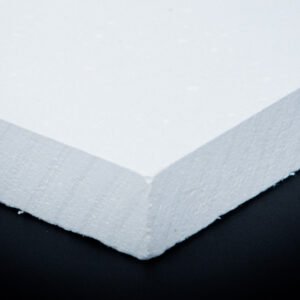
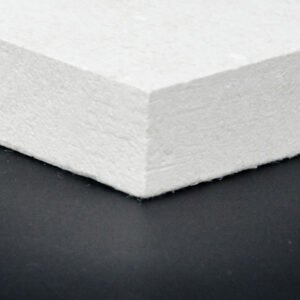
The board is the CSC XPS 250 grade: a calcium silicate cement mortar over alkali-resistant fibreglass mesh on both faces of a Wedge CCXP extruded polystyrene core. Unlike bare XPS, the cement facing protects the core from UV, foot traffic, screed alkalinity and root penetration, so the board can be loose-laid under ballast, bonded under screed or mechanically fixed to a metal deck without a separate protection layer.
It is supplied in 30–100 mm on CCXP 45, 60 and 70 cores; thicknesses above 100 mm come as two factory-bonded layers. For walls, floors and prefab panels see the cement XPS sandwich panel; for the full declared-value sheet see the calcium silicate XPS sandwich panel.
Download the CSC XPS Boards catalogue (PDF)
Full 2026 technical catalogue — five-layer construction, declared values, CCXP core grade selector, floor, roof and wall build-ups, sizes, packing, installation guide and export data. 13 pages, 7 MB.
XPS Roof Insulation Board specifications
Typical production values for cement coated XPS roof insulation boards on CCXP 45–70 cores. Values are determined by the test methods listed and are not a specification — request a Material Test Certificate for the batch supplied where a value must be guaranteed.
| Property | Value | Test standard / note |
|---|---|---|
| Construction | Calcium silicate cement mortar + AR fibreglass mesh, both faces, on closed-cell XPS core | — |
| Thermal conductivity, λ (composite) | 0.030 W/m·K | EN 12667:2001 |
| Thermal conductivity, core at 10 °C / 25 °C | 0.028 / < 0.030 W/m·K | ASTM C518 |
| Thermal resistance RD, core | 0.88 m²·K/W (25 mm); 1.47 (50 mm); 2.06 (75 mm); 2.94 (100 mm); 5.88 (200 mm, two layers) | ASTM C177 / C518 |
| R-value, core (imperial) | R 5.2 per inch (CCXP 45–70) | ASTM C518 |
| Core density | 40 / 45 / 48 kg/m³ (CCXP 45 / 60 / 70) | ASTM D1622 |
| Compressive strength at 10 % | 450 / 600 / 700 kPa (CCXP 45 / 60 / 70) | ASTM D1621 / EN 826 |
| Flexural strength, composite | 2.05 ± 0.02 MPa | ASTM C203 |
| Water absorption, long-term immersion | ≤ 0.7 % by volume | ASTM C578 / EN 12087 |
| Water vapour permeability, Sd | 3.2 m | DIN EN 12086 |
| Dimensional stability, core | 1 % | ASTM D2126 |
| Reaction to fire, composite | Class E | EN 13501-1 |
| Limiting oxygen index, core | 24 % | ASTM D2863 |
| Resistance to body impact | 3 × 120 N/m | ETAG 003 |
| Coefficient of linear expansion | 30 × 10⁻⁶ K⁻¹ | — |
| Service temperature | −30 °C to +80 °C | — |
| Blowing agent | CFC and HCFC free | — |
| Thickness | 30, 50, 75, 100 mm (above 100 mm as two bonded layers) | ±1.0 mm (≤30 mm); ±1.5 mm (>30 mm) |
| Board size | 2440 × 1220 mm (2.98 m²); 2500 × 600 mm (1.50 m²); cut-to-size to 3000 × 1200 mm | ±3 mm |
| Nominal weight | 7.5 kg/m² (30 mm); 12.5 (50 mm); 18.8 (75 mm); 25.0 (100 mm) | — |
XPS core grade selector
The core grade sets the compressive strength of the finished board; choose it from the load the floor, roof or wall will carry.
| Property | Value | Test standard / note |
|---|---|---|
| CCXP 45 — 450 kPa | Hot-climate unoccupied roof under screed or tiles, 30–50 mm | ASTM D1621 |
| CCXP 60 — 600 kPa | Occupied terrace, inverted roof under paving or gravel, 50–75 mm | ASTM D1621 |
| CCXP 70 — 700 kPa | Cold-store roof, trafficked roof, car-park podium, 75–100 mm | ASTM D1621 |
XPS Roof Insulation Board price
XPS roof insulation board is priced per m² by thickness and core grade. Pricing is on application — send the roof area, the target U-value or thickness, the build-up (conventional, inverted or metal deck) and the delivery location, and Wedge Industries Limited returns a thickness recommendation, a U-value calculation for the complete build-up, a board and ancillary schedule and a firm price in ₹ INR and $ USD.
Minimum order is one pallet within India and one 20′ GP container for export: indicatively 860 m² at 30 mm, 520 m² at 50 mm or 260 m² at 100 mm per 20′ GP (2,000 / 1,200 / 600 m² in a 40′ HQ).
Applications
- Flat RCC roofs and terraces under screed, tiles or paving — conventional and inverted (protected-membrane) build-ups (30–75 mm).
- Inverted roofs — board laid above the waterproofing membrane under paving on pedestals, 50 mm screed or 50 mm washed gravel; the membrane is protected from UV, traffic and thermal shock (50–100 mm, CCXP 60/70).
- Metal decks in pre-engineered buildings, warehouses and factory sheds — mechanically fixed with fasteners and 50 mm stress plates (30–50 mm).
- Concrete decks under car parks, podiums and plant rooms (75–100 mm, CCXP 70).
- Roof gardens and green roofs — the cement facing protects the core from root and mechanical damage.
- Cold-store, refrigerated-building and prefab / modular roof panels (75–100 mm, CCXP 70).
Typical build-up — inverted (protected-membrane) terrace roof
| Property | Value | Test standard / note |
|---|---|---|
| 1. Paving on pedestals, 50 mm screed + tiles, or 50 mm washed gravel | Ballast sized for wind uplift and flotation | — |
| 2. Geotextile separation / filter layer | Prevents fines washing into board joints | — |
| 3. Wedge XPS roof insulation board, 50–100 mm, CCXP 60/70 | Loose-laid, staggered, tightly butted | Retains full R-value above the membrane |
| 4. Waterproofing membrane on screed-to-falls | Protected from UV, traffic and thermal shock | — |
| 5. RCC roof slab | Slab kept near room temperature | — |
Installation
- Lay boards tightly butted in a staggered bond directly onto the waterproofing membrane (inverted roof) or onto the slab (conventional roof).
- Inverted roof — cover with a geotextile separation layer and a minimum 50 mm screed, paving on pedestals or 50 mm washed gravel. Ballast must resist wind uplift and flotation.
- Conventional roof under screed — bond boards to the slab with cementitious adhesive or loose-lay, then lay the screed-to-falls and membrane over the boards; the cement facing takes the screed directly.
- Metal deck — fix through the board into the deck with approved fasteners and 50 mm stress plates, five per board; increase at perimeters and corners.
- Cut with a trimming knife against a straight edge, scoring both faces. Do not leave boards exposed to sunlight for more than seven days before covering; do not use solvent-based adhesives or primers on the core; do not expose the board to temperatures above 80 °C.
- Thermal resistance by thickness is tabulated above; total roof U-value depends on the complete build-up and Wedge provides U-value calculations, including compliance checks against the applicable energy code (ECBC / local code), on request.
Sizes, thickness and packing
Standard boards 2440 × 1220 mm (2.98 m²) and 2500 × 600 mm (1.50 m²) in 30, 50, 75 and 100 mm; cut-to-size up to 3000 × 1200 mm for prefab roof panel lines. Square edge standard; shiplap and tongue-and-groove on core boards on request. Above 100 mm boards are supplied as two factory-bonded or site-laminated layers.
Product code: CSC-60-50-2440 = calcium silicate cement facing, CCXP 60 core, 50 mm, 2440 mm length. Boards are stacked flat on fumigated (ISPM 15) pallets to 1.2 m with corner protectors and stretch film; each pallet labelled with product code, batch, quantity and date; MTC per batch on request.
Why buy from Wedge Industries Limited
- Manufactured in Faridabad, India, with group sourcing from the United Kingdom, Spain and China; exported to 45+ countries across the Gulf, Europe, South and South East Asia, Africa and North America.
- Every figure published here is a tested value to the standard stated, not an estimate. A Material Test Certificate (MTC) is issued per batch on request, and a TDS, MSDS and Application Guide are available for every grade.
- Standard formats ship from stock; project quantities and cut-to-size boards are produced to order with a typical lead time of three to four weeks ex-works.
- Minimum order: one pallet for domestic supply; one 20′ GP container for export (indicatively 1,300 m² at 20 mm or 520 m² at 50 mm). Mixed-thickness containers accepted.
- Incoterms offered: EXW, FOB, CIF and DAP. HS code 3921.11 (indicative). Export documentation and compliance support through group company ZJELL Limited.
- Ancillaries supplied with the boards: 100 mm alkali-resistant joint tape, corrosion-resistant screws and 35 mm washers, masonry anchors, flexible C2 S1 tile adhesive, polymer-modified base-coat render and sealant.
Frequently asked questions
Which XPS thickness is best for roof insulation in India?
For a hot-climate unoccupied RCC roof under screed or tiles, 30 to 50 mm on a CCXP 45 core is the usual selection. Occupied terraces and inverted roofs use 50 to 75 mm on CCXP 60, and cold-store or trafficked roofs 75 to 100 mm on CCXP 70. Wedge confirms the thickness against the project U-value target.
What R-value does XPS roof insulation board give?
Declared thermal resistance of the core is 0.88 m²·K/W at 25 mm, 1.47 at 50 mm, 2.06 at 75 mm and 2.94 at 100 mm to ASTM C177 and C518, equivalent to about R 5.2 per inch. Two 100 mm layers give 5.88 m²·K/W.
Can the board be laid above the waterproofing membrane?
Yes. In an inverted (protected-membrane) roof the board sits above the membrane under paving, screed or gravel. Water absorption of 0.7 % or less by volume means the board keeps its R-value when wet, and the membrane is protected from UV, traffic and thermal shock.
Why choose cement coated XPS instead of bare XPS boards for a roof?
The fibreglass-mesh-reinforced cement facing protects the XPS core from UV, foot traffic, screed alkalinity and root penetration, gives Class E reaction to fire for the composite, and lets screed or tile adhesive bond directly to the board without a separate protection board.
How is the board fixed on a metal deck?
Fix through the board into the deck with approved fasteners and 50 mm stress plates, five per board, increased at perimeters and corners for wind uplift. Boards are cut to size on site with a trimming knife.
What is the minimum order and lead time?
One pallet within India and one 20-foot container for export, indicatively 520 m² at 50 mm per 20-foot GP with mixed thicknesses accepted. Standard formats ship from stock; project and cut-to-size quantities take three to four weeks ex-works. The indicative HS code is 3921.11.
Need the full data sheet set? Download the CSC XPS Boards catalogue (PDF) or request the TDS, MSDS and Application Guide with your enquiry.
Related products
- Cement XPS Sandwich Panel — walls, floors and prefab
- Calcium Silicate XPS Sandwich Panel (CSC XPS 250)
- Tile Backer Board — waterproof XPS
- Polymer Cement Coated XPS Board (MXPS)
- Spray Foam Roof Insulation
- Insulation thickness calculator
Request a quotation for XPS Roof Insulation Board
Send the floor, roof or wall area, required thickness or U-value, load case and delivery location. Wedge Industries Limited returns a grade and thickness recommendation, a board and ancillary schedule and a firm price in INR and USD.